Origin, concept, and classification of the Work Feedback Loop

Since publishing the Work-Feedback Loop, I have received a few questions. It is time to address them in an article.
How did the Work Feedback Loop originate/what was the motivation behind it?
In online discussions (primarily on Mastodon), but also at work, I repeatedly found myself asking the question, how do I define agile working? Furthermore, I have increasingly noticed—also for myself—that the term agile is quite overused.
The Work-Feedback Loop emerged from these two perspectives: what is the essence of agile working and how can it be explained without using the term agile?
Ultimately, the point is that we can only work successfully in a fast-paced market if work is closely linked to feedback. It is necessary for feedback to have a direct influence on work. Quote from the first paragraph of the Work-Feedback Loop:
The Work–Feedback Loop is a thinking and diagnostic model that shows whether work in your organization creates real effects, makes them visible, triggers decisions, and actually changes future work. It helps you quickly identify the structural bottleneck that limits adaptability—without debating methods or “agility” as a label.
This concise image is the basis for how the Work-Feedback Loop came about. The development towards a diagnostic model was then the natural next step.
And the term “model” is important to me here. The Work-Feedback Loop is not a method. It is not a replacement for Scrum or Kanban. Nor does it seek to replace other methods and thinking models such as Flight Levels or PDCA.
And that brings us to the second question I have been asked so often.
How does the Work-Feedback Loop position itself in relation to other methods or models?
I think the best way to start is with the following graphic.
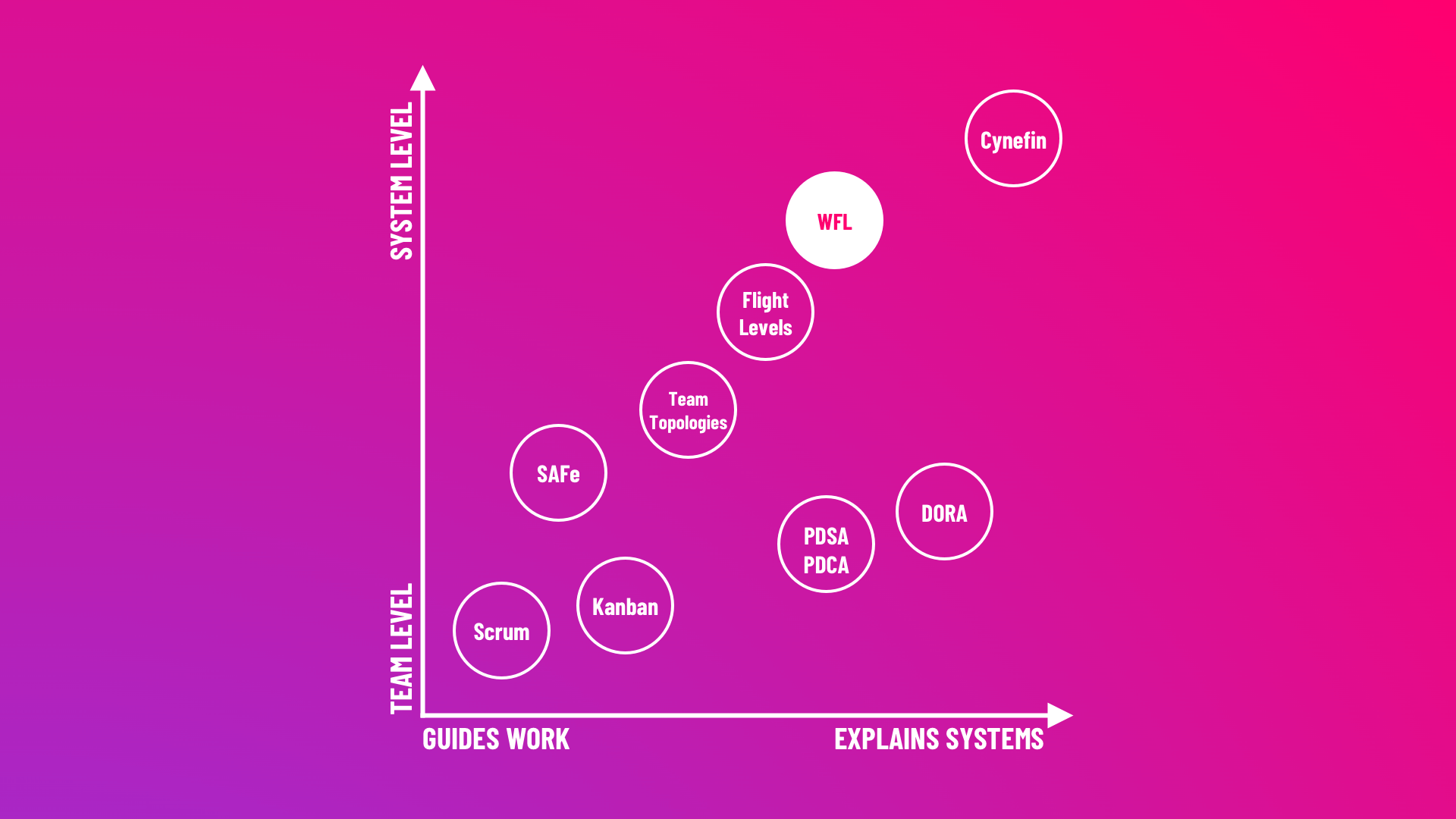
Here, I divide the related terms into the dimensions “team level” or “system level” and “supports work” or “explains systems.”
Methods or models that are more operational and closer to the team are located further down. If they are intended more for daily work, they are located further to the right.
Scrum as a method is located at the bottom left of the diagram. The Cynefin framework as a method for classifying complexity and deriving appropriate decisions and courses of action is at the top right.
The Work-Feedback Loop is intended as a conceptual model for diagnosis. It is not to be understood as an everyday tool or even a method. That is why it is positioned relatively high up. The Work Feedback Loop is very good at diagnosing systems, which is why it is positioned relatively far to the right.
This explains the two big questions for now. Of course, I look forward to further feedback – you can reach me here.
Mastodon Diskussionen
You may also like:

Flight Levels and Nested Work–Feedback Loops: Decision Architecture Meets Learning Physics
Flight Levels describe where decisions are made in...

The Work–Feedback Loop
If Feedback Doesn’t Change Work, It’s Not Feedback....

The Hidden Cost of AI Is the Work–Feedback Loop
If AI were as easy to use as...

The Agile Iceberg: What Actually Drives the Work-Feedback Loop
When organizations talk about agile success, they usually...