The – is a thinking and diagnostic model that shows whether work in your organization creates real effects, is measured against a , triggers decisions, and actually changes future work. It helps you quickly identify the structural that limits adaptability, without debating methods or "agility" as a label.
This conceptual model was developed by Thomas Esders and is made available under the Creative Commons Attribution-ShareAlike 4.0 International (CC BY-SA 4.0) license. This means you are free to use, share, and adapt it as long as you credit the author and publish derivative works under the same license.
Citation/attribution example: "Work–Feedback Loop" by Thomas Esders, CC BY-SA 4.0, https://no-bullshit-agile.com/wfl/.
Contact & Discussion
Feedback and discussions about the model are expressly welcome.
- Website: no-bullshit-agile.com
- Email: nobsagile@gmail.com
- Mastodon: https://mastodon.social/@nobsagile
Version 2.2 - 08/07/2026
1. What this is about
Many organizations are getting faster: more releases, more initiatives, more meetings, more "output." And yet a familiar experience remains: reality changes, but the system doesn't change along with it fast enough.
When that happens, it's rarely a motivation or competence issue. It's a structural issue: is not cleanly coupled to its real effects, and those effects don't reliably change what work happens next.
That is exactly what the Work– is for: a thinking and diagnostic model that makes a system's adaptability visible, regardless of which methods, roles, or process labels are currently in use.
1.1 Practical value
With this model, you can quickly clarify:
Where does feedback stop being "information", and where does it start becoming "consequence"?
(In other words: Where does perception turn into a decision that actually changes future work?)Which limits adaptability the most right now?
Signal (do effects become visible?), Decision (who can reprioritize?), Execution (when does it become effective?), Capital (when can money/capacity really be reallocated?), (does feedback flow across levels?)Why local optimization often looks like progress, but structurally doesn't learn.
(Because activity increases while coupling and responsiveness stay the same.)
The Work–Feedback Loop is therefore not an "adoption program," but a tool to identify direction, cause, and leverage before you try to "improve" anything.
1.2 The core principle: coupling over activity
The core is deliberately simple:
Work → Feedback → Decision → future Work
A system only learns reliably from reality if six conditions are met:
- Work creates a real effect (not just internal activity),
- the work is guided by a : an expectation of what effect it should produce,
- the effect becomes visible as feedback (as a signal, not an opinion),
- the signal is compared against the guiding intent,
- this leads to a decision (priorities/assumptions/resources change),
- and that decision changes future work.
The guiding intent does not have to be a rigid goal. It can be a hypothesis, a strategic direction, or an expected outcome. What matters is that it is clear enough to make feedback evaluable, and open enough to allow for unexpected signals. Without intent, there is no benchmark against which a signal can be measured. Surprise makes information valuable, but surprise requires an expectation.
If any of these conditions is not met, the feedback loop is broken: it may feel productive, but it is not structurally adaptive.
1.3 An example
A product team ships a new feature: a simplified registration flow. The guiding intent is to reduce the drop-off rate during onboarding by one third.
After the release, the team monitors usage data. The drop-off rate decreases, but only by ten percent. At the same time, an unexpected signal emerges: users who complete the new flow drop off more frequently at a later step. The feedback is there, it is measurable, and it deviates from the expectation.
The team brings this insight into the next prioritization round. The decision is made: instead of building the next planned feature, the team first investigates the later drop-off point. Future work changes based on the feedback.
In this case, the loop is closed. Work creates an effect, the effect is compared against the guiding intent, a decision follows, and the next work changes.
Now the counter-example: the same team ships the same feature. But the usage data is only analyzed weeks later, or it never reaches the people who decide on priorities. Or the data arrives, but the next three sprints are already planned and non-negotiable. In each of these cases, the feedback loop is broken. The team keeps working, but not based on what it learned.
This pattern (closed or broken feedback loops) is the core of the model.
1.4 What this document provides
So that the diagnosis doesn't stop at an abstract circle, this document extends the base model along the typical bottlenecks found in organizations:
Chapter 2 – Base model:
Precise terms (Work, guiding intent, Feedback, Decision, future Work) and the condition for when a feedback loop is truly closed.Chapter 3 – Two speeds & system states:
The distinction between work speed and and four typical states. This makes it visible whether a system works fast or learns fast, and where the bottleneck sits.Chapter 4 – Time as a structural variable:
Breaking response time down into signal time, decision time, and execution time. This enables concrete conversations about delay instead of vague "too slow."Chapter 5 – :
Why many systems don't fail at "delivery," but at binding prioritization and decision-making, and how this latency behaves as structural risk.Chapter 6 – Capital coupling:
Adaptation ends where capital/capacity cannot be reallocated. This chapter shows how budget and investment cycles act as a frequency limit, even when teams are operationally fast.Chapter 7 – :
Real organizations have multiple loops (operational, coordinating, strategic). What matters is not only whether a loop is closed locally, but whether feedback flows across levels and synchronizes in time.
1.5 How to read (and use) the model
If you want to use this document as a practical tool, take one concrete unit of work (a release, a meeting, a policy, a reorg) and walk it through the model:
- What effect should it create in reality?
- What guiding intent was behind it, and was it clear enough to make feedback evaluable?
- Is the signal compared against the guiding intent, or does it get lost?
- Where does the signal become visible, and when?
- Who can make a binding decision based on that signal?
- When does that decision become effective, and does it really change what work happens next?
The answers quickly show whether you're looking at a team problem, or a system problem (decision, capital, alignment). And that's exactly what the Work–Feedback Loop is for: coupling reality to the system so adaptation doesn't happen by accident, but becomes structurally reliable.
2. Base model – The Work–Feedback Loop
depends on coupling. The base model in this document reduces organizational learning ability to an elementary relationship.
→ → Work
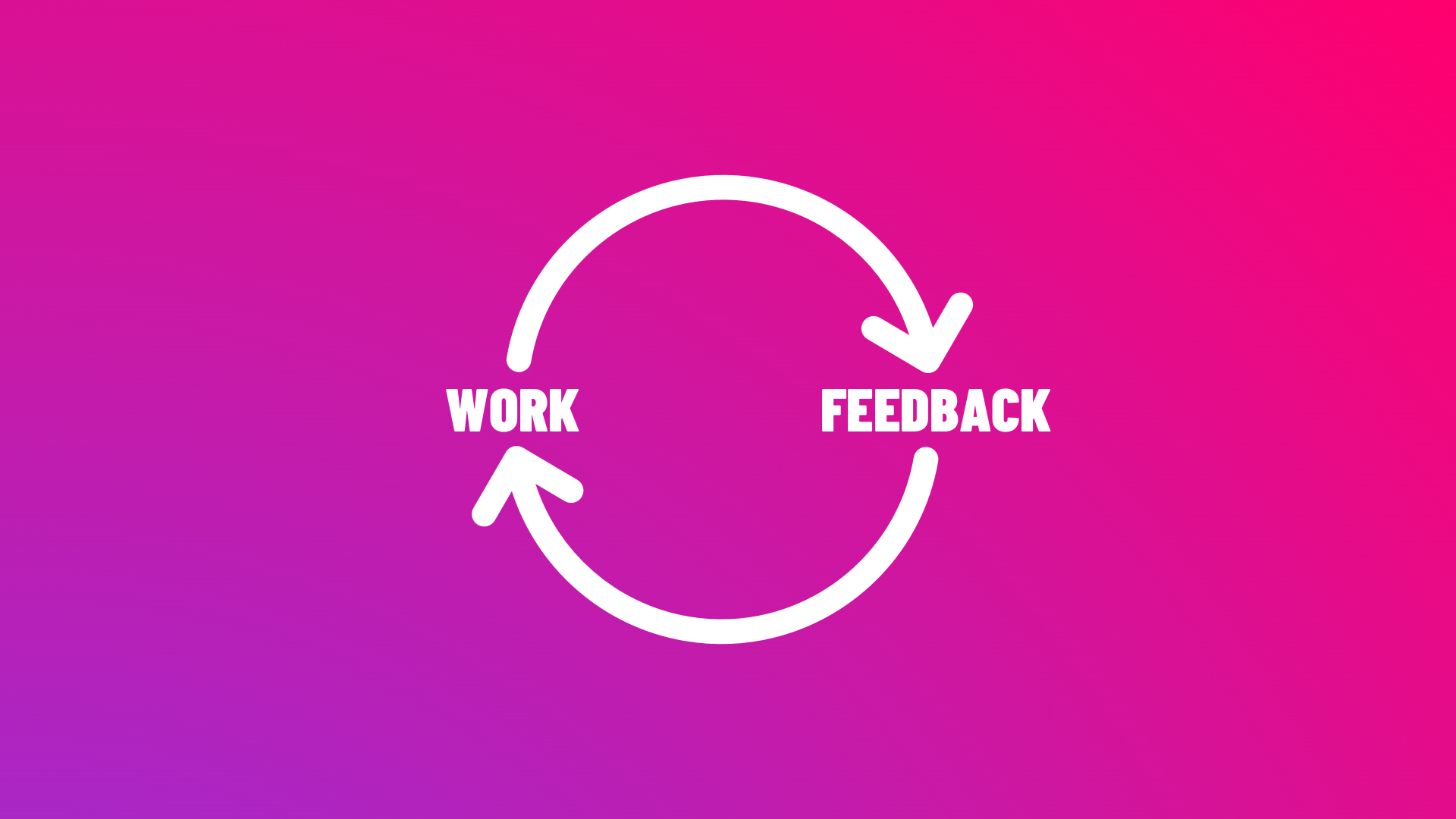
Figure 1: Work-
This cycle does not begin with Work. It begins at any point. The illustration describes a chain of effects, not a rigid chronological sequence. In reality, the elements often run in parallel: while a team is already delivering new work, feedback from earlier work flows back. The circular representation shows structural dependency, not a sequential process.
is the prerequisite for feedback to become evaluable. It is covered in the Feedback section (2.2).
2.1 Work
Work refers to any action that produces an effect in reality. For example:
- A delivered product increment
- A price change
- A changed service structure that directly affects customers
What matters for the model is not the internal activity within the organization, but the real effect in its environment. In the Work–Feedback Loop, only work that produces an effect counts. If there is no effect, the learning signal is missing.
2.2 Feedback
Feedback is the observable reaction of reality to work. This can be:
- Usage behavior
- Market reactions
- Qualitative feedback (e.g., from real usage situations)
Feedback in the sense of this model is a sufficiently valid signal. Fast but misleading signals do not shorten the Work–Feedback Loop—they generate (fast activity without learning gains).
A signal only becomes informative through comparison with the guiding intent. Without an expectation, there is no deviation, and without deviation, no learning impulse. This is precisely why an unexpected signal is valuable: it shows that reality diverges from the assumption.
An internal opinion round without reference to observable effects, for example, is not feedback. Feedback is always an effect that returns to the system.
2.3 Decision
Feedback alone does not generate adaptation. Between perception and change there is always a decision. Decision means:
- Priorities are shifted
- Resources are reallocated
- Assumptions are corrected
Without a decision, feedback remains inconsequential. Decisions can continue a loop, start one, change one, or end one. A decision to launch a new experiment opens a new feedback loop. A decision to discontinue a product closes an existing one. Decision is therefore also the mechanism that shapes the loop itself.
2.4 Future work
Decisions based on feedback from past work must change future work. That is what closes the Work–Feedback Loop.
If the connection between work, feedback, decision, and influence on future work is missing, activity exists but the loop is not closed. The quality of this cycle depends not on motivation, but on the structural coupling of its elements.
2.5 Closed and broken feedback loops
A system is capable of learning when the feedback loop is closed. This means:
- Work creates a real effect
- The work is guided by a guiding intent
- The effect becomes visible as a signal
- The signal is compared against the guiding intent
- Decisions respond to it
- Future work changes as a result
If any of these conditions is not met, the feedback loop is broken. The system may appear productive, but it is not adaptive.
The model stands in the tradition of classic feedback concepts, from Deming's PDCA cycle to John Boyd's OODA loop. It shares with these models the basic idea of a closed control loop. It differs, however, by treating time, , and explicitly as structural variables.
2.6 Speed and reliability
Two properties determine the quality of the loop:
Speed – How much time passes between work and adaptation?
Reliability – How consistently does feedback lead to changed work?
A system can react quickly but unstably. Or stably but extremely slowly. Organizational learning ability emerges when speed and reliability are both high. Only the balance of both creates lasting adaptability. One-sided optimization leads to chaos (only fast) or rigidity (only reliable).
2.7 Reduction
From this perspective, the Work–Feedback Loop is not a framework but intentionally a reduction. It is good at reducing complex organizations and their processes to the following question:
Is the coupling between work and reality closed, fast, and reliable?
3. Two speeds – System states
To assess , it is not enough to look only at the presence of the loop. What matters is the dynamics between its components.
Two speeds must be distinguished:
- Speed of
- Speed of
These two speeds are independent of each other.
3.1 Work speed
Work speed describes how quickly a system produces work that can create real effects.
Common examples are release frequency, time-to-market, cycle time, or decision execution. Work speed is well established in many organizations, visible and measurable.
3.2 Feedback speed
describes how quickly the effect of work returns to the system as a relevant signal.
Examples:
- Time until valid usage data is available
- Time until market reactions become visible
- Time until operational side effects are recognized
- Time until hypotheses can be verified
Feedback speed is often less transparent than work speed.
3.3 Four structural states
If you combine both speeds, four fundamental states emerge. These four states are not project phases, they show the system configuration. The slower of the two elements (work or feedback) acts as the structural for learning ability.
Learning ability is only structurally possible in the Learning quadrant. All other states are forms of partial decoupling.
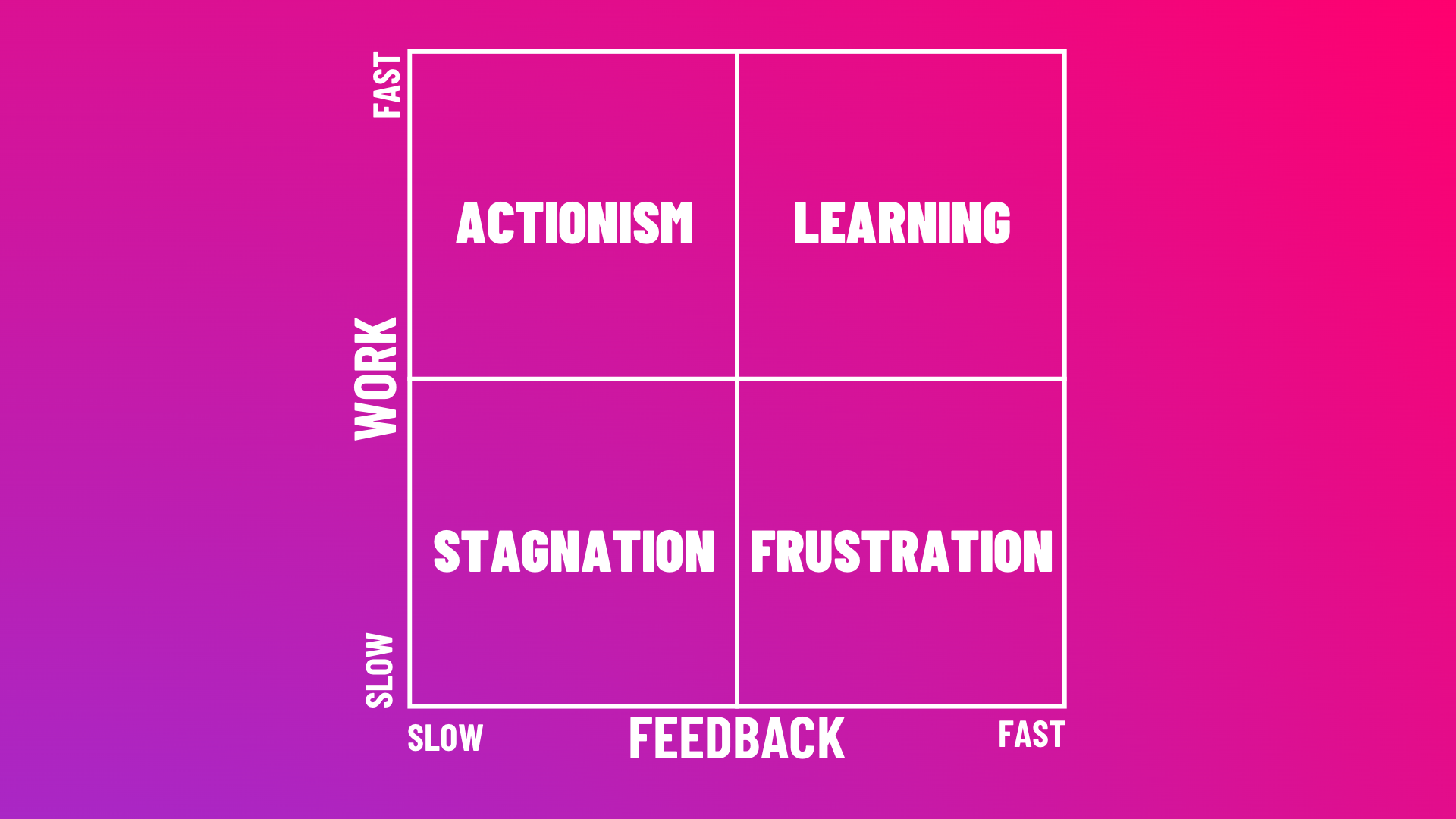
Figure 2: Diagnostic matrix
3.3.1. Learning
When work is delivered quickly in small cycles and feedback reaches the system quickly, work creates an effect. That effect generates a signal that then changes decisions. The system is adaptive. This state must be protected.
3.3.2. Actionism
describes systems that increase their production speed without accelerating their . When work is delivered quickly in small cycles, but feedback generated by that work flows slowly into the system, the system produces continuously but receives delayed or weak feedback. Activity is high, but the learning rate is low. This is Actionism.
The bottleneck here is the processing of reality (feedback).
Typical symptoms include feature growth without clear impact, or high release frequency without strategic adaptation.
3.3.3. Frustration
When work is slow but feedback arrives at high frequency, problems are well recognized but the system does not respond. The bottleneck lies in work speed: the system cannot translate insights into changed work fast enough. This is .
Typical symptoms include many recognized but unimplemented improvements, long execution cycles, or capacity bottlenecks.
3.3.4. Stagnation
When both work and feedback are slow, neither movement nor adaptation is significant. This leads to . Here, both speeds are bottlenecks. The system is doubly blocked.
3.4 States are structural, not cultural
These four states are not descriptions of attitude or motivation. They are structurally anchored.
A committed team can operate in the state of Frustration. A disciplined organization can operate in the state of Actionism. The cause lies not in people, but in coupling speed.
3.5 Diagnosis, not evaluation
This conceptual model does not treat the four states as maturity levels. They serve as a diagnostic instrument. A system can exhibit different states at different levels.
Example: A product team can operate in the 'Learning' state (fast delivery and adaptation), while the portfolio management above it remains in 'Stagnation' due to rigid annual budgets.
According to the Theory of Constraints, the tightest point (the bottleneck) always determines the system's overall performance. Your goal is to find this bottleneck in learning ability. The decisive question is: "What causes the speed differences?"
4. Time as a structural variable
So far the – has been described qualitatively: depends on coupling, the states emerge from different speeds, and structural adaptation is only possible in the Learning state.
To understand this dynamic precisely, another dimension must be introduced: time. Learning ability is not an abstract property but a function of time progressions within the loop.
4.1 Time between signal and change
Between the effect of work and the change of future work lies time. This time—we call it the —consists of three components:
- Time until a signal becomes visible
- Time until a decision is made
- Time until that decision is implemented
This is not a mathematical formula but a structural decomposition. Any delay in one of the three elements extends the system's response time.
4.2 Feedback has a validity window
Feedback is not timeless. It ages and decays. Therefore, every signal has a .
For example, user behavior can change, competitors can react, or the internal context within the organization shifts.
A signal that is not translated into changed action in time loses relevance over time. The value of a signal declines. If the Feedback Response Time exceeds a critical window, feedback loses its effectiveness.
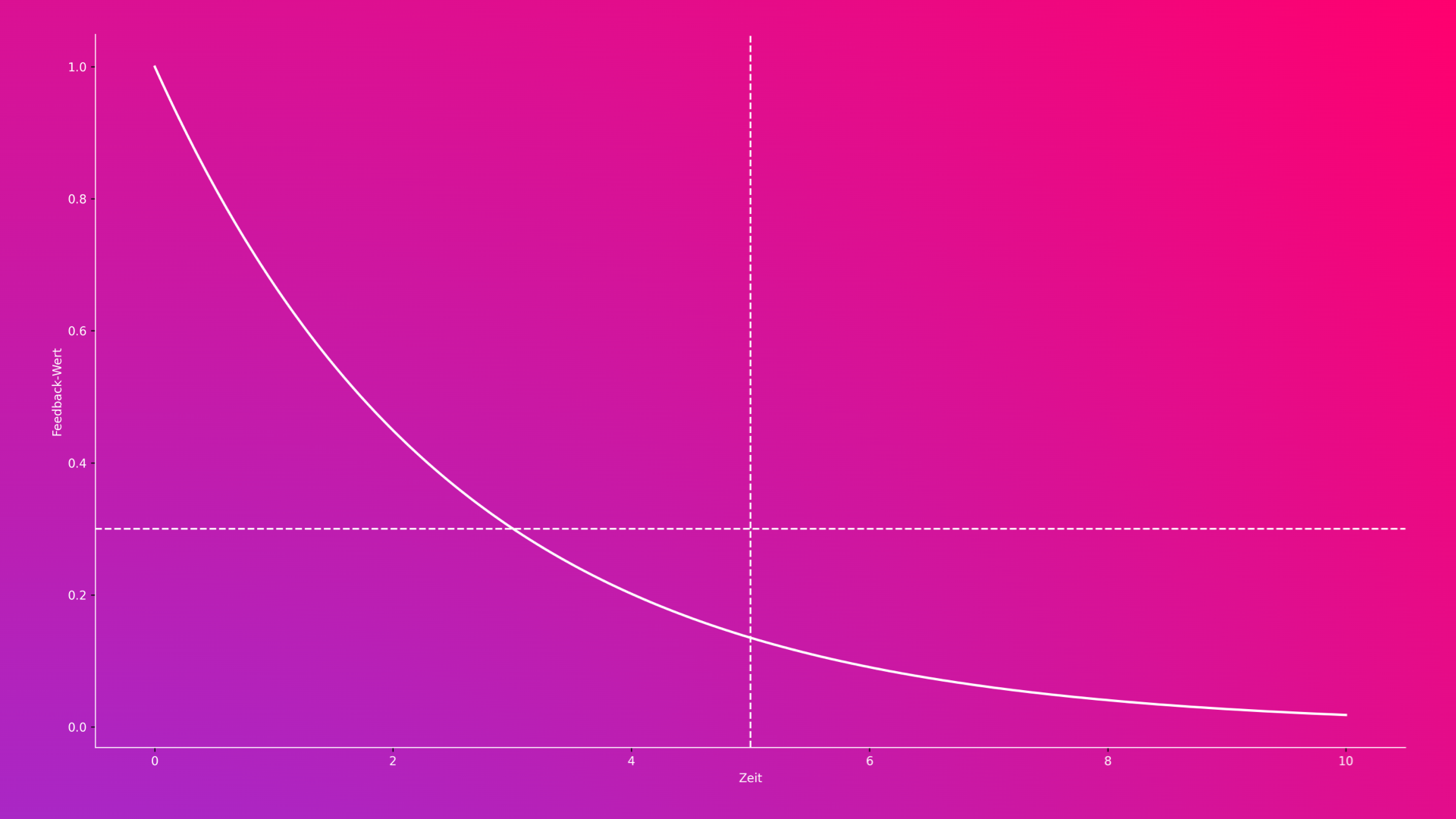
Figure 3: Feedback validity window
The graphic shows three elements:
The falling curve describes the value of the signal over time. It shows that feedback does not remain constantly relevant but loses impact with increasing delay.
The horizontal line marks the minimum . Below this threshold, the signal still exists but is no longer actionable.
The vertical line marks the Feedback Response Time, the point at which the system actually responds.
What matters is the position of this vertical line relative to the threshold.
If the system responds before the curve drops below the relevance threshold, the feedback is still actionable.
If it responds after, the signal is structurally devalued. The system reacts—but too late.
What matters is not whether feedback exists, but whether it acts in time.
4.3 Time as a bottleneck
In many organizations, feedback is present: problems are recognized, feedback data exists. The therefore lies not in the signal, but in the response time.
Typical causes include multi-stage decision processes, committee structures, budget approvals, dependencies between units, and risk mitigation procedures.
These factors extend the decision or execution time.
As a result, the system shifts from the "Learning" state toward "" or "."
4.4 Speed is relative
A short Feedback Response Time is not an absolute value. It is always relative to the signal's validity window. In some systems, a week can be short. In others, a week is too late. The decisive question is: Does the system respond before the signal loses its relevance?
Learning ability only emerges when response time and signal relevance are synchronized.
The decomposition of the Feedback Response Time shows that not all delays are alike. Particularly critical is decision time, because this is where it is determined whether feedback actually produces consequences.
5. Decision latency
The is the sum of signal, decision, and execution. These three delays do not have the same effect.
5.1 What is decision latency?
describes the time span between the moment a relevant signal becomes visible and the moment a binding decision is made.
This time is often invisible, as it hides in coordination loops, committee processes, budget approvals, and many other elements. The longer this phase lasts, the greater the structural decoupling between reality and action.
5.2 Production speed vs. decision latency
A particularly critical case arises when production speed exceeds decision-making ability.
When decisions are made more slowly than new is produced, the loop becomes structurally decoupled.
The operational system continuously generates new work while strategic or prioritizing decisions lag behind. The consequence is often that work accumulates, course corrections are delayed, and feedback does not act synchronously. The system moves faster than it can orient itself.
5.3 Symptoms of high decision latency
High decision latency frequently manifests as:
- Priority changes with significant delay
- Discussions without binding conclusions
- Backlog of initiatives
- Operational teams waiting for approvals
- Strategic insights without implementation
In such systems, feedback is not the problem. The problem is the processing of feedback.
5.4 Decoupling as structural risk
When decision latency exceeds production cadence, a form of decoupling emerges. Operational units work while strategic orientation falls behind. The system can thereby enter the state of : high activity with low rate.
Equally, such systems can enter the state of , when decision latency slows effective work speed to the point where insights exist but cannot flow into changed work fast enough.
Decision latency thus acts as a structural for .
5.5 Latency is not a question of motivation
Decision latency rarely arises from a lack of willingness. It arises from structure: hierarchy depth, diffusion of responsibility, risk minimization, budget cycles, or governance mechanisms.
Learning ability is not a property of culture, but of time and coupling.
6. Capital as a second coupling
Organizations are more than operational systems. They allocate capital, and arises within financial constraints.
Thus, alongside the operational loop, a second coupling layer exists: the .
6.1 Capital cycles
Capital is allocated in cycles: annual or quarterly budget planning and portfolio decisions, often linked to investment approvals and business case logic.
These cycles have their own frequency, and in many organizations it is significantly slower than the operational production frequency.
6.2 Coupling ratio
What matters is the ratio between and production frequency. The more tightly coupled the two are, the faster an organization can respond financially to operational insights. The further the frequencies diverge, the greater the .
6.3 Structural rigidity
When the capital frequency is significantly slower than the production frequency, an asymmetry emerges. The operational system can learn quickly, but capital decisions respond only at long intervals.
Insights remain without effect, experiments cannot be scaled, course corrections are financially blocked. The system may appear operationally adaptive, but it is strategically rigid.
6.4 Capital as a frequency limiter
Capital cycles act as a frequency filter. They limit how fast an organization can structurally respond.
Even when emerges quickly, decisions are made quickly, and teams deliver quickly, adaptability remains limited as long as capital is only periodically redistributed.
In such cases, the lies not in the Work–, but in capital coupling.
6.5 Consequence for learning ability
Organizational does not end at teams or product decisions. It ends where capital can be realigned. If capital frequency is not synchronized with production frequency, a structural limit to adaptation emerges.
7. Nested loops
So far one level has been in view: operational creates an effect. That effect generates . Feedback changes decisions. Decisions change new work.
In real organizations there are multiple loops of different scope and frequency.
7.1 Three levels of coupling
In simplified terms, three levels can be distinguished:
Operational loop Cadence: days or weeks Focus: execution, delivery, immediate impact
Coordination loop Cadence: weeks or months Focus: prioritization, dependencies, resources
Strategic loop Cadence: months or years Focus: direction, positioning, portfolio, business model
Each of these levels has its own decision cycles, feedback sources, and time constants.
A note on framing: This structure draws on established models of modern organizational development (e.g., Flight Levels).
The key difference lies in focus: while models like Flight Levels describe how the right work becomes visible at the right level and how strategy, coordination, and operations are connected (cf. Leopold, Flight Levels: Leading Organizations with Business Agility, 2024), the Work– examines the chronology and frequency (How fast does the system learn?).
We use these levels here not to design communication structures, but to make the temporal asynchrony between operational urgency and strategic rigidity measurable.
7.2 Frequency differences
The cadence of these loops differs.
Operational loops run faster than coordinating ones, and coordinating ones faster than strategic ones. This is not inherently problematic. Different scopes require different cadences. It becomes problematic only when feedback does not flow between levels.
7.3 Alignment
Between levels, implicit coupling ratios exist. When the strategic level responds only rarely to operational reality, a growing gap emerges.
The consequence is that the strategic direction remains constant even though operational signals suggest change. The operational units then optimize locally without achieving systemic adaptation. A form of phase shift emerges: operations and strategy run asynchronously and work against each other.
7.4 Disconnected Agility
I call this state : operational loops work fast while strategic or coordinating loops remain sluggish.
In this state, the system appears agile at the team level but remains structurally unchanged.
Typical patterns: teams deliver regularly, but portfolio decisions rarely change. Experiments are conducted, but results are not reflected in budget decisions. Retrospectives generate local improvements without strategic consequence.
Here, the operational loop is closed, but the strategic loop is not synchronized.
7.5 Synchronization as a prerequisite
Organizational does not arise solely from a fast operational loop. It only arises when feedback flows along levels and is translated into decisions at each level in a timely manner. Learning ability is therefore a property of nested systems, not of individual teams.
The question is not only whether the loop is closed. It is whether the loops across levels are aligned with each other.
The structural components of the conceptual model are therefore:
- Coupling between work and reality
- as the benchmark for feedback
- Two speeds (work and feedback)
8. The conceptual model as an analytical instrument
The – does not describe a process model. It defines no roles, events, artifacts, or implementation steps. It reduces complex organizations to a structural core question:
Is the system able to respond to reality in time?
This reduction is deliberate. It allows analysis without prescribing interventions.
8.1 Diagnosis before intervention
The model is not suited for direct optimization. It is suited for diagnosis.
These guiding questions walk you through the diagnosis:
- What is the real effect, and is it observable?
- Was the clear enough to make the feedback evaluable?
- How quickly does this effect become visible as a signal?
- How long does it take for a decision to follow?
- How long does execution take?
- Which loop is currently the ?
- Is capital synchronized with operational reality?
- Are strategic and operational loops aligned?
Only when these questions are answered can an intervention be meaningfully chosen.
8.2 Bottleneck logic
In every system, a dominant bottleneck exists at any given time. It may lie in signal transparency, , execution capability, capital allocation, or level .
The model allows this bottleneck to be located without prematurely changing processes.
8.3 Measurability
Not all components need to be precisely quantified, but every element has a time dimension. How long does it take until a market signal is available, a priority is changed, a budget is shifted, or a strategy is adjusted? Even rough estimates make structural differences clearly visible.
The strength of the model lies not in mathematical precision, but in structural clarity.
8.4 A different view of agility
From the perspective of this conceptual model, agility is not a collection of practices or methods.
In this model, agility is the ability of a system to compare feedback against a guiding intent and translate it into changed work in time. A system can use Scrum and still be structurally sluggish. A system can reject formal Agile methods and still be highly adaptive. What matters is not the label, but the coupling speed.
8.5 Summary of the model
Organizational is a function of time, coupling, latency, frequency, and synchronization. The Work–Feedback Loop offers a structured perspective on these relationships. It does not replace methods. It evaluates their structural impact.
Agile work can therefore be analyzed independently of frameworks.
Glossary
Actionism
State of high production speed with low feedback speed. The system produces continuously but receives delayed or weak feedback.
Adaptivity
The structural ability of a system to respond to changing environmental conditions. Adaptivity describes not an attitude or culture, but the actual capacity for adaptation.
Alignment
Temporal synchronization between nested feedback levels (e.g., strategy, coordination, operations).
Bottleneck
The factor that most strongly limits the overall system's adaptation speed.
Broken feedback loop
State in which at least one coupling between work, guiding intent, feedback, decision, and future work is missing. Productivity is possible, adaptivity is not.
Capital frequency
Time constant of capital allocation. Determines how often financial constraints can be adjusted.
Capital loop
Structural coupling between capital allocation and operational reality.
Closed loop
State in which:
- Work creates a real effect
- The work is guided by a guiding intent
- The effect becomes visible as a signal
- The signal is compared against the guiding intent
- A decision follows
- Future work changes
Only closed loops are adaptive.
Decision latency
Time span between the visibility of a signal and a binding decision.
Disconnected Agility
State of fast operational loops with sluggish strategic or capital-related loops. Operational dynamics are present, but strategic adaptation is absent.
Feedback
Observable reaction of reality to an action ("Work"). Only becomes informative through comparison with the guiding intent. Feedback is not a meeting, not an opinion, and not planning—it is a real effect that flows back into the system.
Feedback loop
Structural relationship between action and effect, in which the effect influences future action.
Feedback Response Time
Total duration between signal emergence and effective adaptation, consisting of: time until the signal becomes visible, time until a decision is made, and time until implementation. Describes the temporal dynamics of the closed loop.
Feedback speed
Time until a real effect becomes visible as a relevant signal within the system.
Frustration (system state)
State of high feedback speed with low work speed. Problems are well recognized, but the system cannot translate insights into changed work fast enough.
Guiding intent
The expectation of what effect work should produce. Makes feedback evaluable by providing a reference point for comparison with observed signals. Must be clear enough to make feedback evaluable, and open enough to allow for unexpected signals.
Learning (system state)
State of synchronized work and feedback speeds. Work creates an effect, the effect changes decisions.
Learning ability
The structural capacity of a system to learn from reality. Describes architecture and coupling—not performance.
Nested loops
Multiple feedback levels with different time constants (e.g., strategy, coordination, operations).
Production speed (also: work speed)
Frequency at which work is produced that can create real effects.
Relevance threshold
Minimum value of a signal at which it is still actionable.
Stagnation
State of low production and low feedback speed. Neither movement nor adaptation is significant.
Structural rigidity
State of high capital or decision latency with simultaneously high operational speed.
Validity window
Time span during which a feedback signal remains actionable. If the Feedback Response Time exceeds this window, the signal structurally loses relevance.
Work
Action with real effect in the system's environment. Internal activity without external effect does not count as work in the model.