EN - No Bullshit Agile2026-01-18T15:56:42+01:00Thomashttps://no-bullshit-agile.comThe Hidden Cost of AI Is the Work–Feedback LoopThomashttps://no-bullshit-agile.com/ai-work-feedback-loop-cost.html2026-01-18T15:33:50+01:00
If AI were as easy to use as many posts suggest, it wouldn’t require this many posts explaining how to use it. Over the past months, a clear pattern has emerged in AI-related articles in blogs, podcasts and posts on social media, especially on LinkedIn. The focus is no longer…
]]>
If AI were as easy to use as many posts suggest, it wouldn’t require this many posts explaining how to use it.
Over the past months, a clear pattern has emerged in AI-related articles in blogs, podcasts and posts on social media, especially on LinkedIn. The focus is no longer on spelling correction or summarization. Those use cases are commodities by now. Instead, the attention has shifted to much bigger promises: AI for Product Management, HR, Marketing, process automation, even strategy.
What is revealing is not the ambition behind these promises. It is the amount of guidance required to make them work. There are pages-long blog articles and long youtube videos explaining all necessary steps and controls required to make AI “successful” — without acknowledging what this complexity implies. And the authors don't even recognize it.
Most of these articles are not describing simple tools that teams can pick up and use. They describe carefully constructed setups that rely on elaborate prompt instructions, chained interactions, manual validation steps, and repeated human intervention to prevent subtle but costly errors. The more ambitious the use case, the more scaffolding appears around the AI.
These details matter, because they reveal something fundamental. This kind of AI usage is not a plug-and-play accelerator. It is exploratory work. The outcomes are uncertain, variance is high, and feedback is delayed. Progress does not come from execution speed, but from repeated inspection and correction.
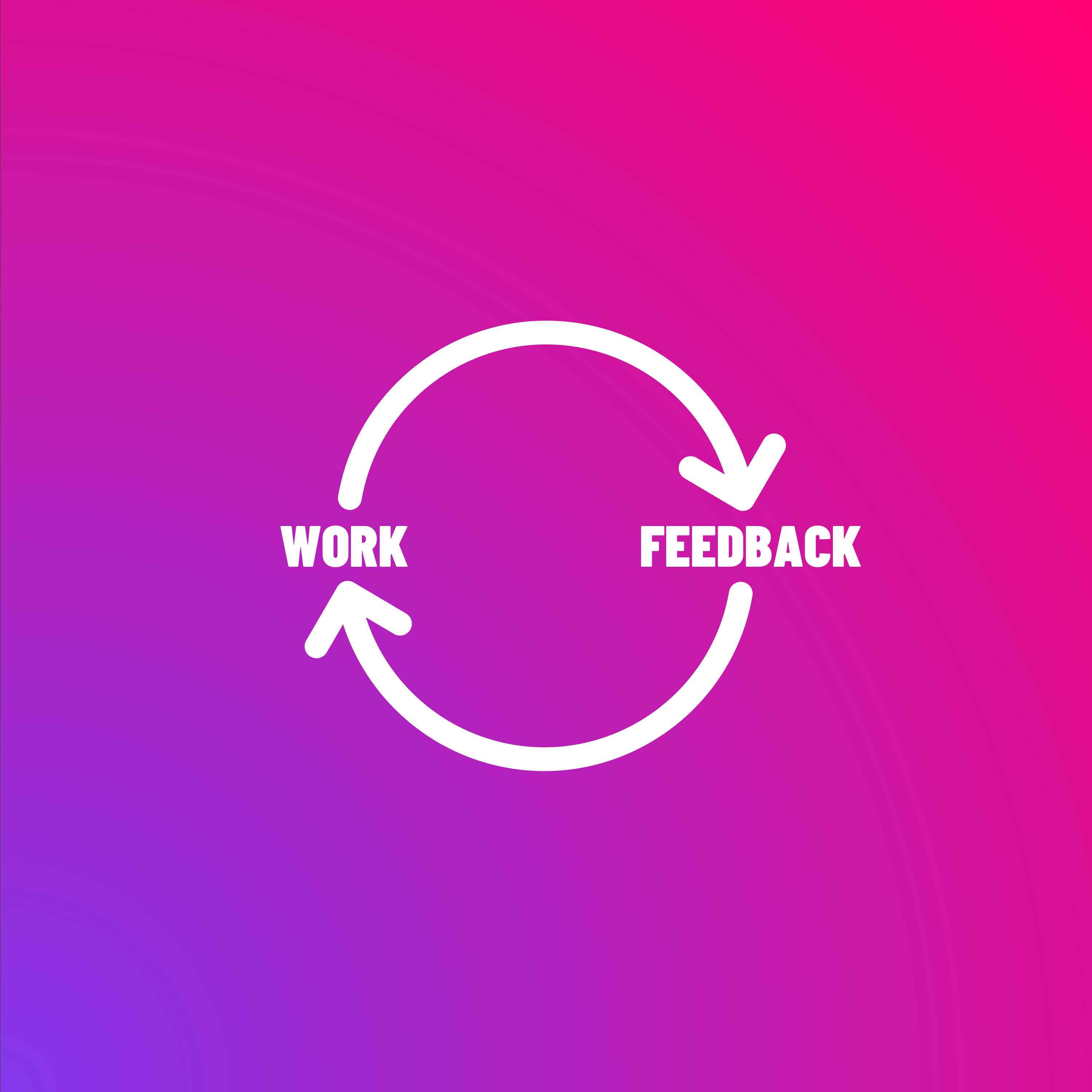
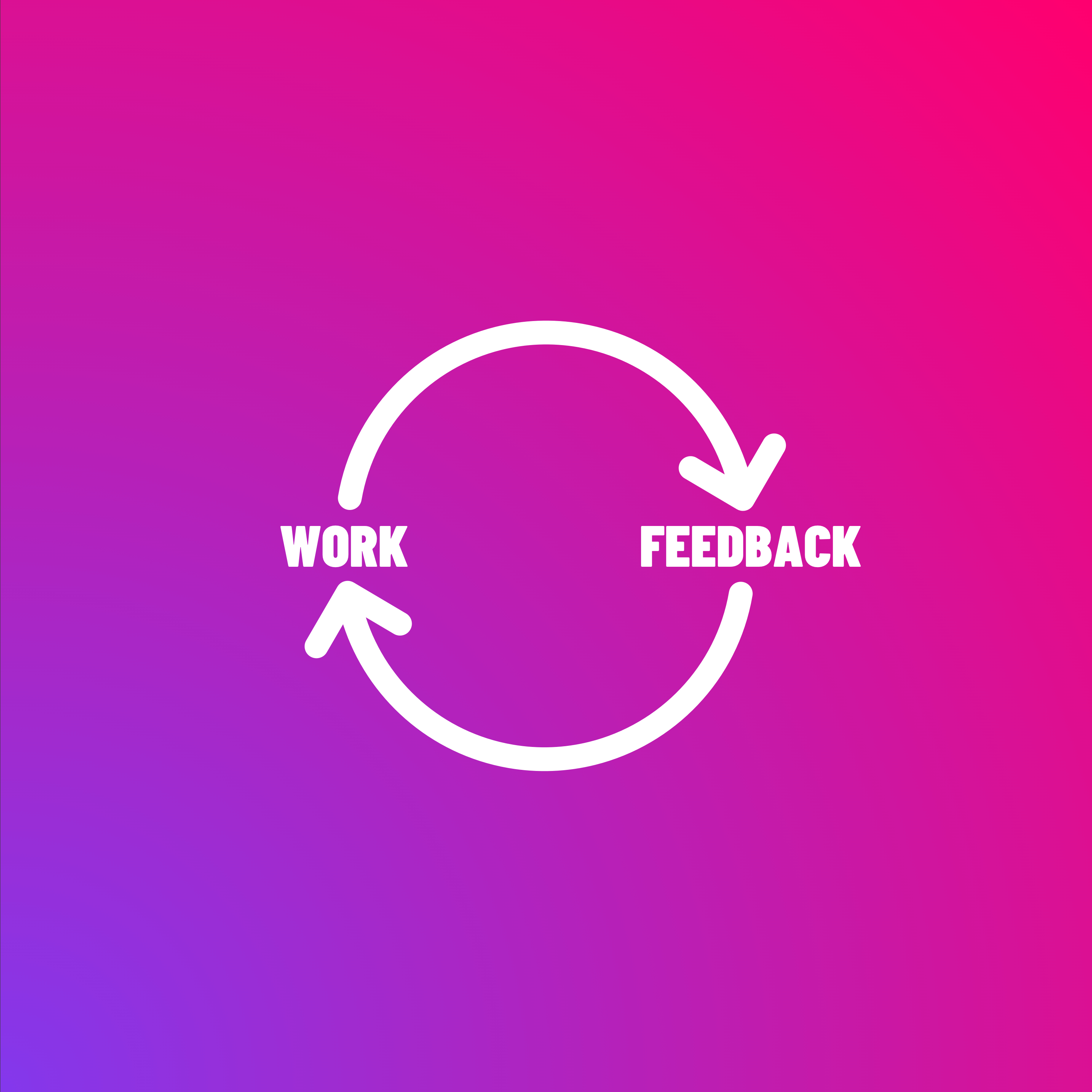
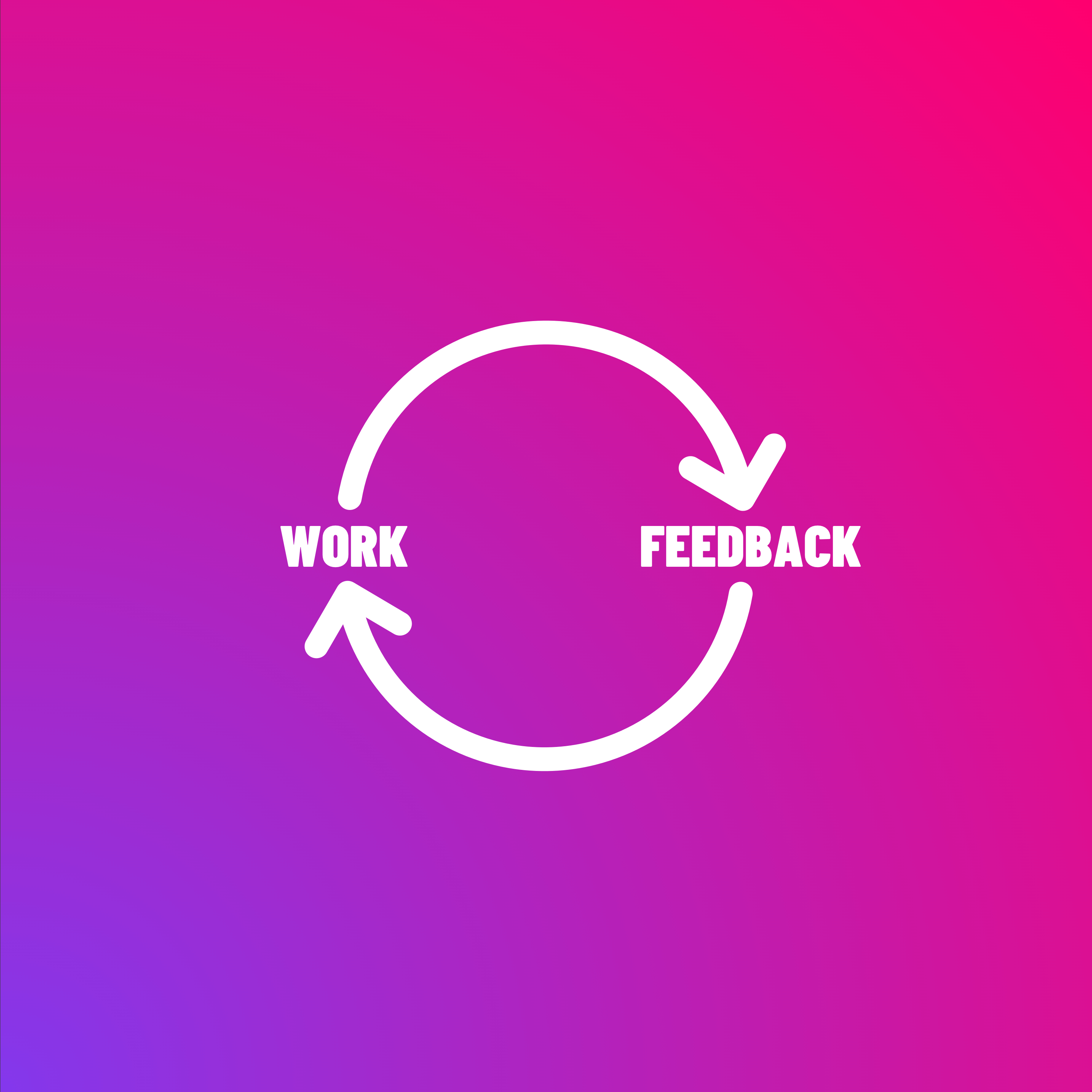
This is where the real cost of AI adoption sits. Not primarily in tokens. Not in tooling licenses. The dominant cost is hidden in the work–feedback loop.
Someone tries an approach, inspects the output, adjusts the prompt, adds another safeguard, reruns the process, and evaluates again. Each cycle looks small in isolation. Together, they form a slow and expensive learning loop that is easy to underestimate, especially when the initial demos look impressive.
The paradox is that the more guidance a system needs, the more carefully we should ask where real feedback actually enters the system. Who notices that something is wrong? How quickly does that information affect the next decision? And how expensive is the correction once a mistake slips through?
Before adopting AI, it is worth being explicit about what you are trying to achieve. Are you running an experiment to explore a problem space and generate insight? Or are you trying to accelerate an existing workflow that already works reasonably well?
Both are valid goals, but they have very different economics. In experimental settings, slow and costly feedback loops are often acceptable because learning itself is the objective. In operational workflows, however, those same loops can quietly erase the promised efficiency gains.
In many cases, AI does not reduce the cost of work. It shifts it. And unless the surrounding work–feedback loop is deliberately designed and measured, that shift often makes work more expensive long before it ever gets cheaper.
]]>
The Agile Iceberg: What Actually Drives the Work-Feedback LoopThomashttps://no-bullshit-agile.com/the-agile-iceberg.html2026-01-14T15:22:20+01:00
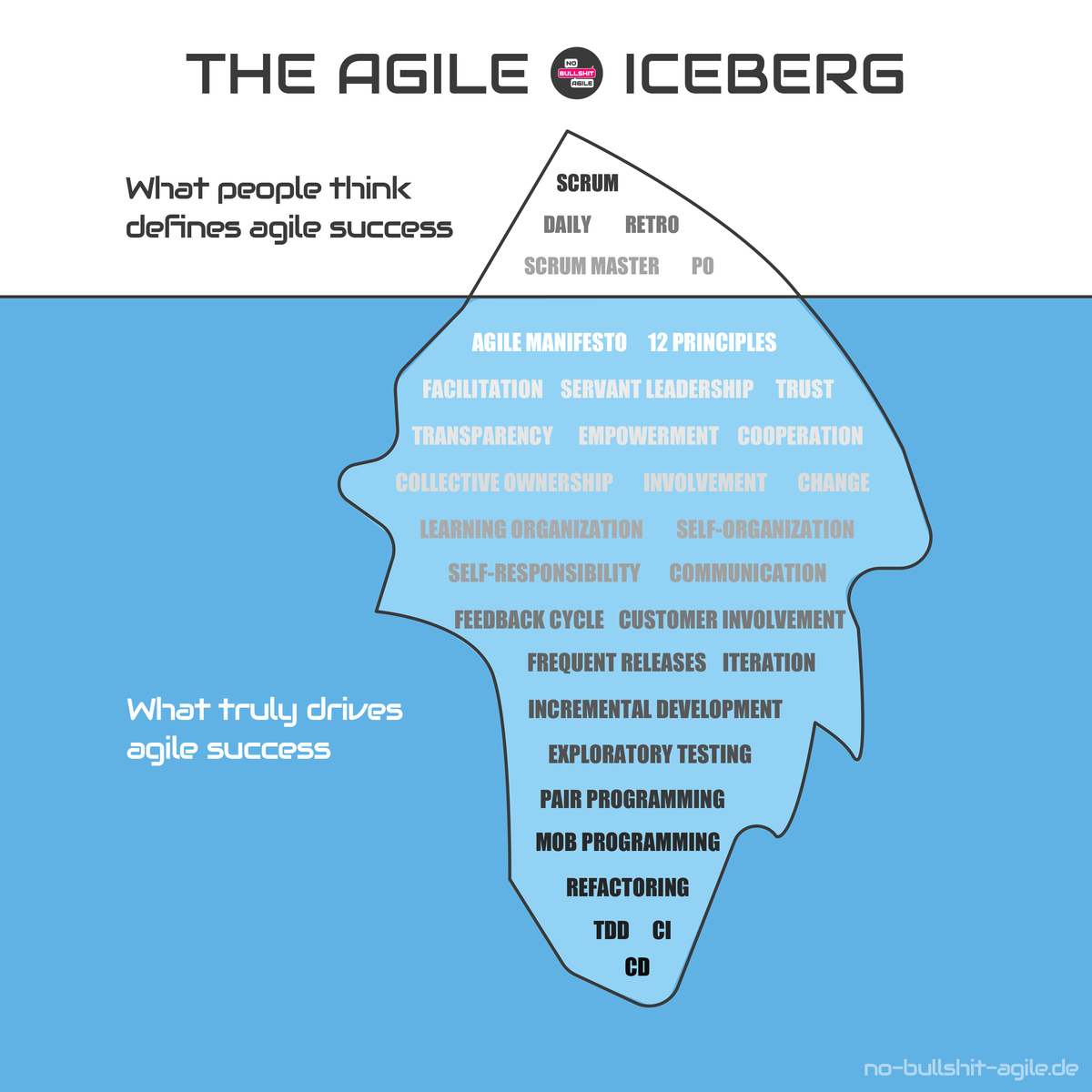
When organizations talk about agile success, they usually list things they can see on a calendar: Daily Stand-ups, Retrospectives, and Sprint Plannings. They hire Scrum Masters, buy Jira licenses, and call it a "transformation." But these are just the tip of the iceberg—the visible rituals of agility. Like a real…
]]>
When organizations talk about agile success, they usually list things they can see on a calendar: Daily Stand-ups, Retrospectives, and Sprint Plannings. They hire Scrum Masters, buy Jira licenses, and call it a "transformation."
But these are just the tip of the iceberg—the visible rituals of agility. Like a real iceberg, the parts that actually determine whether you move or sink sit below the waterline. If the loop between Work and Feedback isn't getting faster or safer, you aren't "being agile"; you're just participating in expensive theater. Let's look deeper into that.
The Tip: The Surface of "Mechanical Agility"
At the top sit the practices that are easy to buy and easy to measure, but they are enablers, not drivers:
Frameworks (Scrum, SAFe, Kanban): Rules that organize activity but don't guarantee a single ounce of value.
Rituals (Dailies, Plannings): Synchronization points that, without the right skills, devolve into mere status reporting.
Defined Roles: New titles that often hide old command-and-control power structures.
This level represents Mechanical Agility. It feels busy, but it’s an illusion of progress. If you stop here, you've essentially hired a world-class pit crew for a car with a broken engine. You are optimizing for activity (the theater) instead of learning (the craft). Try to look below the waterline!
The Waterline: The Great Lie Detector
The waterline is where the theater meets reality. It acts as a filter: Everything above the line is a promise; everything below is the actual capability to keep that promise. If your teams do "Sprints" (above) but have a brittle architecture and a manual testing process that takes weeks (below), the waterline becomes a wall. You see the motion, but the work never reaches the truth of the market.
Below the Surface: The Operational Physics of the Loop
The real power of agile work lies in the load-bearing structures beneath the water. These aren't "soft topics"—they are technical and economic necessities that determine the latency of your feedback loop.
1. Operational Principles (The Economic Engine)
Decision Latency Reduction: Real agility isn't about "empowerment" as a feeling; it's about the technical and organizational ability to get a "Yes" or "No" in minutes, not weeks.
Economic Reason: The realization that every unvalidated feature is an expensive inventory of risk. If you aren't shipping, you're just gambling with the company's money.
Technical Judgment: Moving away from "following the process" to "reasoning about the system." Skills beat manuals every time.
2. Engineering Discipline (The Load-Bearing Foundation)
This is where most icebergs melt. Without technical excellence, the rituals at the top become a dead weight that sinks the ship.
Technical Confidence: The capability to push the "Deploy" button on a Tuesday afternoon without heart palpitations. This isn't a mindset; it's the result of rigorous CI/CD and automation.
Slicing & Decoupling: Engineering the work into tiny, independent units. If your architecture is a "Big Ball of Mud," your feedback loop will always be slow, no matter how many Daily Scrums you attend.
Technical Debt Management: Treating the codebase as a production tool, not a landfill. Continuous refactoring is the only way to keep the cost of change affordable.
3. Cultural Integrity (The Feedback Fuel)
Time to Truth: How long can you lie to yourselves before a real user tells you the feature is useless? Culture determines if truth is welcomed as data or punished as a failure.
Psychological Safety as a Performance Metric: Safety is not about being "nice." It's about the speed at which technical risks and mistakes surface so the loop can react.
The Stress Test for Your Iceberg
Don't look at your Jira velocity to measure agility. Ask these two diagnostic questions to see if you've addressed the layers below the surface:
The Dependency Test: If we cancelled all meetings (the tip) today, how long would it take for the team to realize they are building the wrong thing? (This measures your Feedback Capability).
The Fear Test: How many people have to sign off before a developer can push a small, safe change to production? (This measures your Operational Friction).
Conclusion: Stop Polishing the Tip
Frameworks organize your ignorance. Technical and operational skills eliminate it. If your "Agile Transformation" is focused only on the tip of the iceberg, you are burning money on narrative work—work that only describes the system instead of moving it.
Real agile work happens below the waterline. It's the hard, often invisible labor of building technical confidence and reducing decision latency. It's about mastering the craft so the Work-Feedback Loop can finally spin at the speed of reality.
The label is burnt. The work begins.
Welcome to the workshop.
]]>
Why AI in 2026 Makes the Same Waste Visible as MeetingsThomashttps://no-bullshit-agile.com/ai-costs-waste-flow.html2026-01-12T19:05:05+01:00
AI is not a toy anymore AI – or more precisely: LLMs – has become established. Everyone uses it. Some use it well, some less well. But that’s not what this is about. I’m concerned with the economic side of using AI. The OpenAIs of this world have managed to…
]]>
AI is not a toy anymore
AI – or more precisely: LLMs – has become established. Everyone uses it. Some use it well, some less well. But that’s not what this is about. I’m concerned with the economic side of using AI.
The OpenAIs of this world have managed to keep token prices low since 2022 (roughly in the range of $2–$10 per 1 million tokens, depending on the model). As a result, the costs for many use cases were practically negligible.
I believe that will change in 2026. Time to look at the implications.
We will see a mix of pay-per-token and volume contracts. And in that mix, costs will become relevant – so relevant that they will force decisions. That’s good, because the discourse shifts: away from “AI can do everything” toward “Is this use of AI worth it for us?”. Only then does a feedback loop emerge.
As soon as AI costs money, usage patterns become visible – and assessable.
The return of a familiar kind of waste
The nice thing is: we already know this situation. I’ll use a different example to make the point clear: meetings.
Meetings have low per-instance costs. The frequency is high. And often there is no feedback on impact. That is exactly why meetings are rarely questioned consistently.
Why is that? Meetings convey activity. Coordination feels like work – and therefore like value. But soberly speaking, a meeting is not automatically valuable.
With AI it’s similar. Each individual prompt is written quickly. And the responses from LLMs are designed in such a way that they often create a feeling of success and progress. We have the impression that we are being productive.
Waste rarely comes from big wrong decisions, but from frequently repeated, barely examined micro-costs.
AI without a work-feedback loop
In every activity – large or small – there is a work-feedback loop. Without feedback, we may have done work, but we don’t know whether it was meaningful.
When using AI, we see typical cases in which exactly this feedback part is missing:
Summarizing without a decision
Analyzing without consequences
Generating without use
Important: Output is not the same as impact. That shows: AI amplifies systems – it does not correct them.
Put more precisely: tokens do not create value.
Value only arises when a decision is made or a system state changes. If that doesn’t happen, tokens are a cost item without value creation. And that happens often – precisely because AI is so easily available. We are subject to the false assumption that more information automatically leads to better results.
Value does not arise from knowledge, but from effective decisions.
Visibility is not progress
There is another level: psychology.
AI is also readily used for psychological reasons. Besides the mechanism that LLMs often deliver agreement and a “sense of progress,” motives such as control, modernity, and the feeling of momentum come to the fore. We already know these feedback effects: status meetings, dashboards, or agile rituals – likewise often without real impact.
Too often it’s about narrative work instead of system work. Many AI applications buy reassurance, not flow.
When costs become visible
What happens when costs rise? In that moment, waste becomes measurable: How many tokens did we need for this ticket description? How many for this meeting summary? How many for this decision?
Then you quickly find: under budget pressure, the evaluation of AI use turns out differently. The flow problem – AI as an activity generator without impact – was already there before. Relevant costs only make it impossible to ignore.
Economics doesn’t discipline – it exposes.
What AI will actually demand from teams
What does that mean? Teams must clearly distinguish between work that moves systems and work that only describes systems. With AI use, the central question will become louder: does it make our decision better or faster – or just better justified?
This is not a tool question. It is a system question.
AI forces teams to focus on impact – not efficiency.
Closing thought
AI does not destroy bad systems. It makes their costs visible. If you didn’t have flow before, you now get a bill.
It won’t be AI that will change companies, but the clarity about what they are burning money on.
]]>
Your Team Is Not Slow. Your Feedback Comes Too Late.Thomashttps://no-bullshit-agile.com/feedback-comes-too-late.html2026-01-10T11:12:56+01:00
When software teams seem "slow," it's almost never because of execution speed. It's because feedback arrives weeks or months late – when learning has become expensive or impossible. When a feature takes months to release, and we encounter surprises shortly before go-live, have to pivot, or postpone releases and do…
]]>
When software teams seem "slow," it's almost never because of execution speed. It's because feedback arrives weeks or months late – when learning has become expensive or impossible.
When a feature takes months to release, and we encounter surprises shortly before go-live, have to pivot, or postpone releases and do rework, the damage is already done. If we only start discussing whether we did "the right thing" at that point, we have a problem.
The root cause is usually that the feature was too large, that teams perceive releases as an event rather than a routine, and that feedback is understood as an event at the end of a release.
That exactly is the fallacy. Feedback does not belong at the end - it is a core component of the Work-Feedback cycle. And this cycle must be small.
If we put feedback at the end, we have no opportunity to learn and adjust course. We are speculating. And that is expensive.
This has nothing to do with discipline, mindset, or motivation. It is a systemic misunderstanding of how agile working must function.
The consequences are harsh but logical. No learning. Activity is mistaken for progress. Those who work this way aren't slow. They just learn too late.
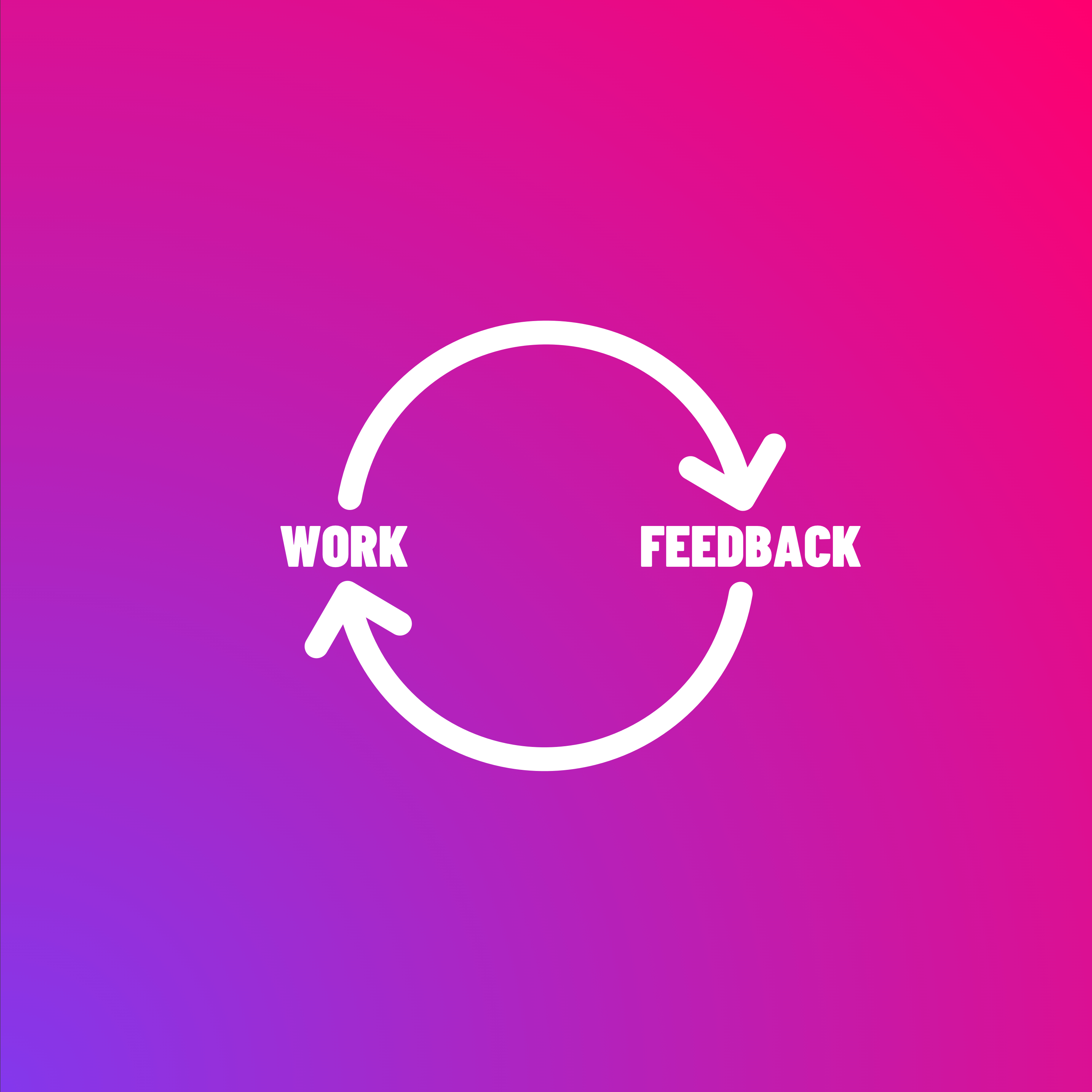
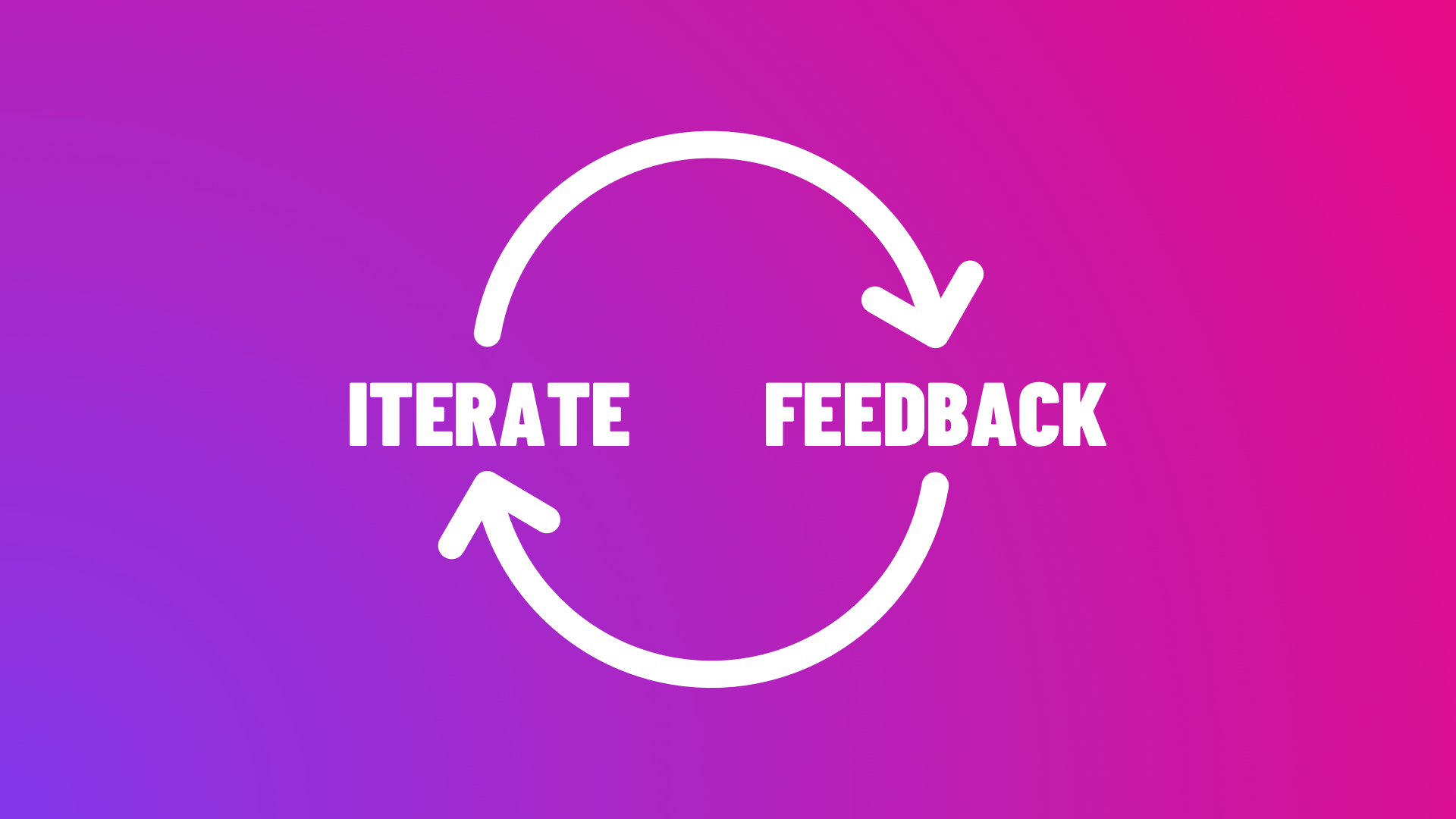
Work is a cycle. Work → Feedback → Adjustment. Everything that prolongs this cycle increases the risk.
If we are unable to accept this, we waste our potential. We have enough measures for this in our toolbox. What is missing is a clear view of this toolbox and the courage to apply it, even when it hurts.
It doesn't require new tools, methods, or roles. It requires the acknowledgment that the Work-Feedback cycle is the core, and it takes the courage to implement measures from the toolbox.
If you can't release your work to learn something, you're not working agily – no matter what your meetings are called.
If you want to know how late you really learn, honestly answer these questions.
How long does it take from "idea" to real feedback?
When was the last time you released something just to learn?
What is currently preventing feedback from arriving sooner?
Teams don't become slow because they work poorly. They become slow because they learn too late.
]]>
Forget "Agile" Theory: The Only Cycle That Really MattersThomashttps://no-bullshit-agile.com/agile-working-feedback-loop-skills-over-frameworks.html2026-01-09T12:57:20+01:00
Have you ever wondered why we are actually putting on this whole circus? We trudge to Dailies, we estimate Story Points like fortune tellers at a fair, and we fill Jira boards beyond recognition. But at the end of the day, it still takes months for a line of code…
]]>
Have you ever wondered why we are actually putting on this whole circus?
We trudge to Dailies, we estimate Story Points like fortune tellers at a fair, and we fill Jira boards beyond recognition. But at the end of the day, it still takes months for a line of code to reach the actual user.
We have lost ourselves in framework discussions. We argue about SAFe vs. Scrum while our craft is rotting. It is time to end the "Agile Theater" and focus on what Agile Working actually is at its core.
If we strip away all the baggage – the certificate mills, the role descriptions, and the rituals – this is what remains.
That is all. Agile Working is not a management concept, but an economic survival strategy in a complex world. We build something functional (Work), we let it collide with reality (Feedback), and we adjust our course based on what we have learned.
The golden rule is: Your agility is not measured by the number of your certificates or lines of code, but by the speed of this cycle.
Speed is Nothing Without Guardrails
„If we just code faster, the system will collapse!“
Correct. If you just blindly step on the gas, you will end up in the ditch sooner. When I say we need to accelerate this cycle, I don't mean "hectic." I mean the technical and organizational ability to learn quickly without sacrificing quality, security, or user experience.
To make this cycle fast and stable, we don't need new meetings. We need Skills.
The Tool Wall of the Craft
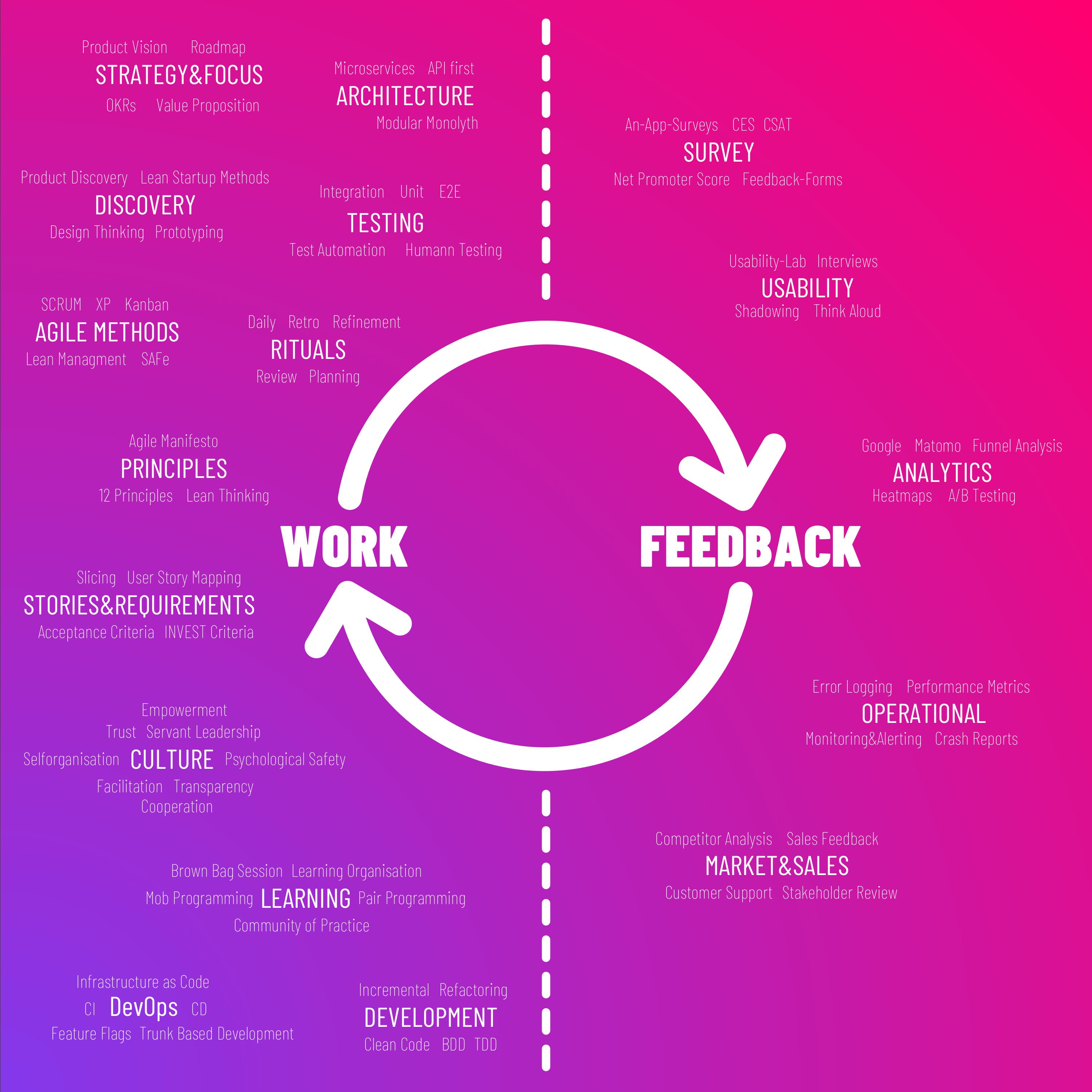
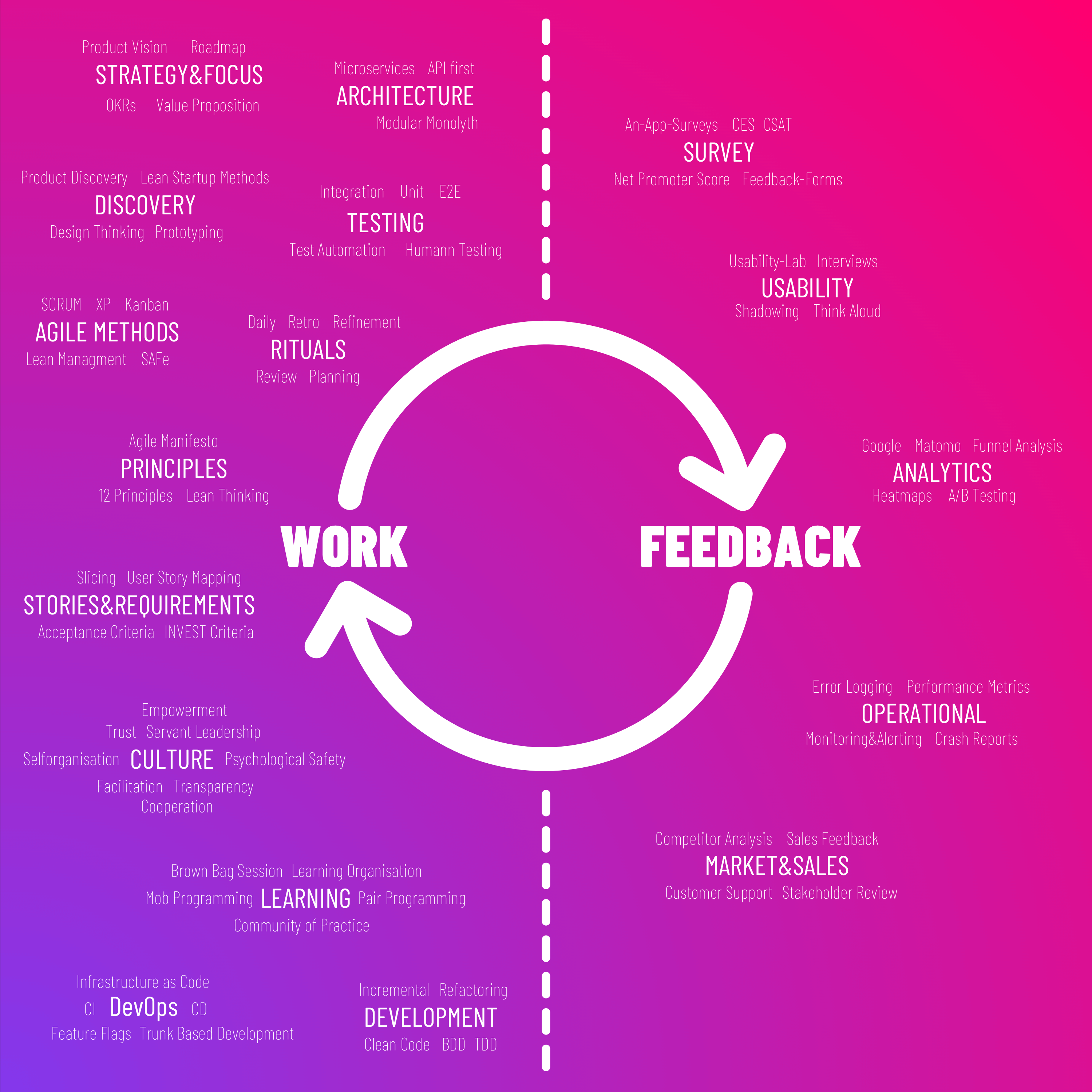
To shrink the Work-Feedback Cycle from three months to three weeks (or three hours), we have a whole wall of tools at our disposal. What you see here in the graphic is not even complete. Neither in the major themes, nor in the individual elements per theme. But that is not what matters anyway.
To truly accelerate the cycle, we must work on both areas simultaneously: We must increase the quality of our work (Work) so it can flow safely, and we must professionalize our channels for learning (Feedback).
1. The Left Side: Work (Building with Confidence)
The left side of the graphic comprises everything we do before and while we write code. These points (from architecture to rituals) have a common goal: to make the output as stable and precise as possible. We divide them into three levers:
The technical foundation (Architecture, Development, Testing, DevOps): This is about defeating fear. Modularity and automation are not religious prescriptions, but technical risk management. They ensure that we are even capable of producing changes on an assembly line without the system blowing up in our faces.
The content direction (Strategy, Discovery, Stories & Requirements): We use Product Discovery and radical slicing to avoid "running faster in the wrong direction." Good preparation makes work units small and thus the entire cycle short.
The social operating system (Culture, Learning, Agile Methods & Rituals): Psychological safety and continuous learning are the lubricants. Without them, work gets stuck in silos or in the fear of making mistakes. Methods and rituals are only a means to an end here, not an end in themselves.
2. The Right Side: Feedback (Ending the Guesswork)
The right side ends the blind flight. Once the work is "out there," the most important part begins: the reality check.
The human voice (Usability & Survey): We don’t wait three months to know if a feature is understood. Usability labs and direct user feedback are the early warning systems that protect us from expensive misdevelopments.
The hard reality (Analytics & Operational): Numbers don’t lie. Whether through Matomo, error logging, or performance metrics – this is where we get feedback directly from the system. Those who ignore this data aren't working agily, they are working hopefully.
The economic proof (Market & Sales): In the end, the market decides. Feedback from sales and competitor analysis tell us whether our work has actual economic value or was just "feature trash."
Important Note: A team should never try to implement everything at once. Use this map as a tool wall: pick the 1-2 measures that have the greatest leverage in your current situation to noticeably shorten the cycle TODAY.
All of this aims at delivering the smallest possible, valuable increments and checking if they create real value. The collected feedback on the increment then flows back into the planning for the next increments. This way, we manage to deliver the right thing at any time. "Right" here simply means: what brings a benefit to the user of the system.
So it sounds very logical that we want to concentrate on this cycle and accelerate it as much as possible. Entirely in the interest of the user.
Your Strategy: Pick your Battles (The 80/20 Rule)
The biggest mistake organizations make: they try to "introduce" a framework. They buy the whole menu when they actually just need a glass of water.
Stop trying to "be agile." Start analyzing your pain. Use the map above like a compass:
Identify the bottleneck: Where do you lose the most time? Does testing take two weeks? Then your construction site is "Testing" (Unit Tests, Automation). Do you have no idea if the users like the feature? Then your construction site is "Analytics" or "Surveys."
Choose the smallest measure: Pick the things that cost little effort but immediately shorten your feedback cycle (the "Low Hanging Fruits").
Measure instead of believing: Measure your Cycle Time. How long does it take from the idea to the feedback? If a measure does not shorten this time, it is baggage.
Conclusion: Back to the Workshop
2026 is the year we stop discussing agility as a religion. We must perceive it again as what it is: a craft.
Agile Working requires technical judgment, economic sanity, and the courage to leave gaps. A team that masters its Work-Feedback Cycle doesn't need a 500-page framework manual. It just needs the right skills.
The label is burnt. The work begins.
Welcome to the workshop.
]]>
Work & Feedback: Why You Need Skills, Not FrameworksThomashttps://no-bullshit-agile.com/iteration-feedback-skills-not-frameworks.html2026-01-04T14:11:14+01:00
The label “Agile” is burnt, as I already analyzed in my last article. Does that also mean that “Agile” itself is burnt? No! We just have to look closer: If we throw away all the baggage of role descriptions, certification circuses, Jira workflows, and colorful post-its, what is left? It…
]]>
The label “Agile” is burnt, as I already analyzed in my last article. Does that also mean that “Agile” itself is burnt? No! We just have to look closer: If we throw away all the baggage of role descriptions, certification circuses, Jira workflows, and colorful post-its, what is left?
That is the entire core. Agile working is not rocket science; it is a mercilessly honest cycle: build something functional in short cycles, get real feedback, and permanently adjust the course. That’s all it is. But that is exactly where the problem lies: most companies haven’t mastered this core – and they hide their inability behind 500-page framework manuals.
The Fairytale of “We can’t release more often”
Whenever I talk about this topic online, I get the following answer over and over again.
Thomas, that sounds nice with the feedback. But we are an enterprise environment. Technically, we can only release every three months. Our architecture doesn’t allow for anything else.
My answer is harsh but honest: That is a lie.
It is not a God-given law that software takes three months to reach the customer. It is a decision not to invest in the necessary craft. Anyone who says “I can’t release more often” actually means: “We are afraid of our own code.” (Yes, there are exceptions, such as legal requirements...)
We must stop discussing agility as a management method. We must start perceiving it as a craft.
The Skill Gap Behind the Process Curtain
Why does it take three months? Because manual testing eats up weeks. Because deployment is a high-wire act without a safety net. Because nobody knows what happens if you pull on Module A while Module B is still hanging by a thread. Because there is no good planning and no story decomposition.
If your environment is complex – and it usually is, otherwise you wouldn’t need agile working – then the only way to minimize risk is to reduce the size of the units.
If your stories, and therefore your iterations, are too large, your risk of developing something the customer doesn’t need at all increases exponentially. If the feedback comes too late, you spend three months building something that misses the market. This becomes very expensive.
To break this vicious cycle, we don’t need new meetings; we need technical excellence. Testing, CI/CD, feature flags, and decoupled architectures are not “nice-to-have” developer gimmicks. They are the basic prerequisite for the word “Agile” to have any meaning at all. And believe me, you’ll be preaching to the choir with the devs. They have probably been demanding this for a long time or discussing it behind closed doors (in the retro).
Those who cannot release quickly cannot learn quickly. Those who do not learn quickly do not work agilely. They are just doing waterfall in expensive sprints.
The Good News: It Can Be Learned
The beauty of this realization is: missing skills are not destiny. You can work on them!
If you notice that your feedback cycle is too slow, then that is your most important backlog item. Forget the next feature. Make sure that the three months become three weeks. Then three days. Does that sound expensive? It is! But developing something that takes three months until it is released, only to find it doesn't fulfill what the users actually wanted, is even more expensive.
These steps require hard work on the system and on your own skills.
You must learn to slice tasks better. If a feature is too large for a quick release, you have sliced it incorrectly. There is always a smaller, value-adding part.
You must learn to automate. Every manual test is a brake on your agility. Decouple the release from the deployment: with feature flags, you can bring code live without immediately activating it for everyone. This takes the pressure off and increases the speed of feedback.
Regardless of whether your business card says Product Owner, CTO, Tech Lead, Scrum Master, Release Train Engineer, or Agile Coach: your job is not to moderate ceremonies. Your job is to clear the way for iteration and feedback.
If you work in a complex environment, the overhead of agile working (the meetings, the slicing, the coordination) is only justified if you actually get the power onto the road.
Stop hiding behind frameworks like SAFe, Scrum, or Kanban. Look at your feedback cycle. Is it too long? Then work on your skills instead of calling for new methods.
Agile working is a craft. And 2026 is the year we finally start building again.
]]>
The "Agile" label is burnt. Agile work as a craft is just getting started.Thomashttps://no-bullshit-agile.com/agile-label-burnt-agile-work-craft.html2025-12-30T13:14:21+01:00
If the label "Agile" carries so much baggage that it prevents solutions, then we have to let it go. In 2026, we end Agile theater and start building again. Exhaustion around the topic of "Agile" is everywhere. Be it in social networks, in teams, or in companies. This is primarily…
]]>
If the label "Agile" carries so much baggage that it prevents solutions, then we have to let it go. In 2026, we end Agile theater and start building again.
The Ashes of the Hype – Why the Label Is Finished
Exhaustion around the topic of "Agile" is everywhere. Be it in social networks, in teams, or in companies. This is primarily because "Agile" has become a container for anything and everything – from micromanagement under a new name to the pure self-occupation of the "method guardians".
The consequence: Anyone still wanting to "introduce agility" in 2026 no longer creates a sense of momentum, but only defensive reactions.
Why I Have Always Spoken of "Agile Work"
Some noticed it right at the beginning. I don't say agility; I say agile work. I chose these words deliberately – here on the blog, in the podcast, and also in the book.
Agility is a (now burnt) noun that sounds like a static target state. That approach is wrong from the start. Agility is also not a goal; it is a means to achieve a goal.
Agile work therefore describes much better what it should actually be about: We work in an agile way because we want to achieve a goal. The goal is to deliver good software quickly in a complex environment. We want to create value, not waste. There is only one approach to that: iteration and feedback. And that is hard work. By the way: agile work is nothing more than that. Iteration and feedback.
The Logic of the System – Why Frameworks Often Prevent the Work
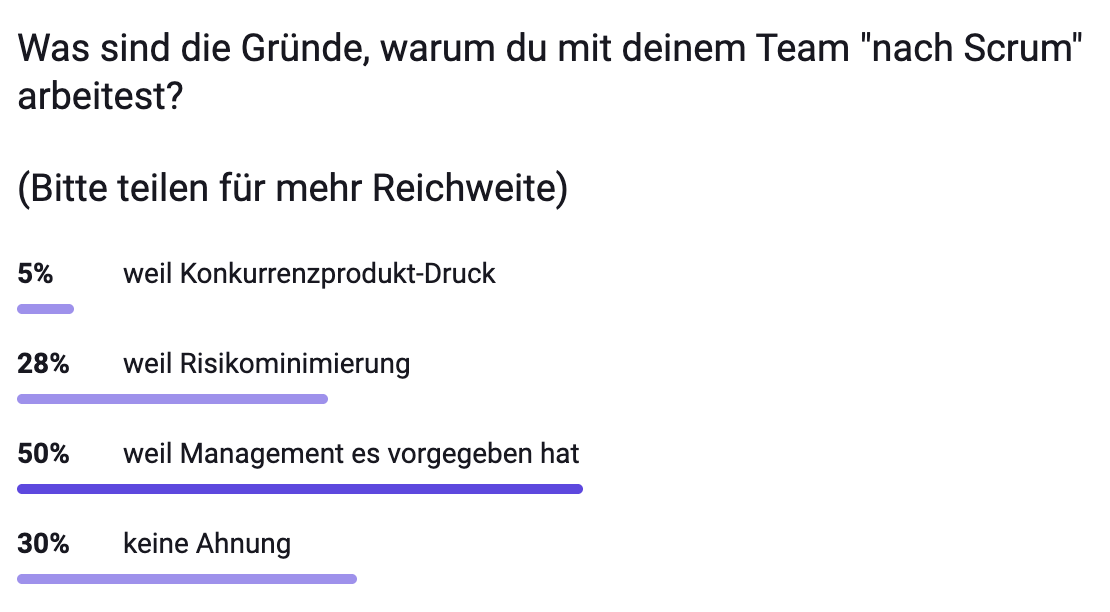
80% of all participants either have no idea why they are doing Scrum or clearly say that it was mandated from above. And how did management come up with Scrum anyway? Did they really want to create more value, and did they really have the chance to understand whether Scrum would help them do that?
In such an environment, we don't need to talk about which framework might be better – that ship has sailed. Everyone will reject this discussion. The topic is perceived as a foreign body. No wonder that today on LinkedIn, as a solution to a question of mine, I read more than once that several people are calling for new terms, methods, or frameworks.
That is not the way. It is clearly foreseeable that all of this will just be old wine in new bottles. The new terms, methods, and frameworks will all burn just the same.
The belief that you create more value by changing role titles and introducing regular stand-ups sounds absurd. The way out: no missionary work, but an honest discussion about benefits. We stop educating people to become "agile believers" and start solving their real pain points in the craft.
Craft - agile work. I am not alone with this view. Approaches like the ‘Agile Primitives’ by Stefan Wolpers point exactly in this direction: away from complex rulebooks, back to the fundamental building blocks that make collaboration effective. It’s not about the success of a framework, but about the success of the work.
When we talk about pain points, we should also be honest enough to say that agile work is first and foremost an overhead. The rituals, spreading the mindset, slicing requirements, the feedback cycles. All overhead and expensive. Therefore, a pain point analysis must also take a close look at whether the work even needs all of this.
Unfortunately, many people forget that. There is work that does not need to be implemented in an agile way. If it is simple enough to predict very precisely what the outcome should be and how it should be implemented, then we don't need "agile." Repetitive tasks. Why put something on top of it that was designed for completely different situations and is expensive?
The Developer as Architect – Craft Beats Ticket Shuffling
Developers saw through the theater the fastest. They have been frustrated for a long time. They have long wanted to "just work." They are tired. Their motivator is to deliver software in good quality that serves a purpose and is actually used.
So why does that collide with "agile" reality? Because in most companies, we are not talking about agile work. Methods and frameworks were sold to them, whether they fit or not.
In theory, viewed soberly, agile work and the motivation of devs described above should go together. Agile work without architectural understanding, clean code, test automation, and feedback – in other words, everything we also understand as technical excellence – only leads to us "running in circles faster." That doesn't improve anything. And that is exactly where implementations of agile work in companies fail today.
I am convinced: the new currency in 2026 will be technical judgment. It will be about the craft. It will be less and less about pushing tickets in Jira or standing together every morning.
There is another development that will support this.
AI as the Merciless Bullshit Filter
"AI" is a very broad term, so I need to be more precise. I am primarily talking here about the use of LLMs in development. I think after three years of public LLMs, we see things clearly. For me, little has changed in this area in 2025 – especially when I compare it with 2023 or 2024. It is clear what LLMs can do and what they cannot do. Of course, the ecosystem around LLMs has continued to grow (agents, MCP, CLIs, ...). But everything is based on a language model. And that technology simply did not change significantly in 2025.
So it's time to look at where we stand and where the journey is heading. It is clear that the correct use of LLMs has cost-saving potential. I am talking about one-shot prototypes that can be thrown away, more advanced code completion, or scanning code for quality, security, and performance. There is potential here, and we all use it.
It is also clear that the dream of some – at least no longer needing juniors and thus saving personnel costs – is not "coming true." There are many examples of companies that tried this path and then backed off. That is the logical consequence. We cannot replace juniors. They are the seniors of the future. Otherwise, where are the architects of our software supposed to come from? Likewise, LLMs are not able to replace seniors because they require constant supervision.
What many people don't even consider in the discussion yet: today, API calls to LLMs cost a few cents. But it is obvious that this is not cost-covering. It is also clear that the time will come when investors want to see a return on their invested money. This will lead LLM providers to raise prices, because ads in code are hardly an alternative. And when the monthly budget for LLMs moves from €2,000 toward €10,000, the step to hiring a human who is actually intelligent is not far.
For what then remains of LLM usage, the principles of agile work are perfectly suited to integrate it. Prototyping, testing, code completion – all technologies we need for our fast feedback cycles.
2026 – The Return to Economic Reason
I predict that 2026 will be a great year for real agile work. But only for this real work – not for the unreflected use of frameworks or the consulting that introduces the same methodology over and over again. Inventing new frameworks or introducing new names will not save anyone either.
In 2026, we will see the end of the "wars of belief" (Scrum vs. Kanban vs. SAFe). Companies will once again demand operational effectiveness and results in short cycles.
Good!
The logical consequence: away from the master of ceremonies, toward the enabler who recognizes and removes obstacles in the value stream. The label is dead. The work begins.
Welcome to the workshop of agile work.
]]>
Why Good Developers Hate "Just Processing Tickets"Thomashttps://no-bullshit-agile.com/why-good-developers-hate-ticket-shuffling.html2025-12-25T19:05:27+01:00
This article is part of the Developer Survival Kit. Developers are not ticket machines; they are problem solvers. Learn how to reclaim your autonomy and deliver real value instead of just shuffling Jira statuses. Whenever someone from the dev team asks me in a refinement or a daily what we…
]]>
Developers are not ticket machines; they are problem solvers. Learn how to reclaim your autonomy and deliver real value instead of just shuffling Jira statuses.
Whenever someone from the dev team asks me in a refinement or a daily what we are actually trying to achieve with a ticket, I’m happy every time—even if I know it means a bit more work for me to answer that question. I know exactly why the developer is asking me.
Apparently, however, such a question is not popular in all companies. In many organizations, the ticket is the law and Jira is the judge.
No wonder developers are frustrated. They have every right to be!
The Misunderstanding: Tickets = Work
Tickets are meant to make work visible. They are supposed to help plan, prioritize, and coordinate things.
The problem begins when tickets replace the work instead of supporting it.
A ticket is not a problem. A ticket is a representation of a problem—usually highly simplified, often stripped of context.
Those who develop software don't work on tickets. They work on problems, connections, and consequences.
What actually drives good developers
In my opinion, good developers want to understand why something is being built. They want to be allowed to make decisions instead of just executing instructions. They are very interested in feedback—especially from real users of the system. And they want to finish things, not just pass them on.
They don't optimize for "busy"; they optimize for "done." And that's exactly where the friction arises.
How ticket processing destroys work
In many companies, a silent role change occurs: problem solvers become status managers. This can often be seen through the following symptoms.
Tickets are handed over instead of solved together. There is no time for discussion, planning, or architecture.
Responsibility ends at column or status boundaries. Asking a question about a ticket is rather unwelcome. A ticket didn't become "Ready" through a conversation, but because it’s sitting in "Up Next." For exactly this point, feel free to check out my Deep Dive.
Context is lost with every handoff. Because talking or thinking about tickets is discouraged (as it's supposedly "more efficient"), context is lost every time a ticket changes hands.
And then, of course, there's this: Success is measured by how many tickets were "pushed through." The holy cow: "Velocity." In some companies, even lines of code (yes, I’m looking at you, Microsoft). Why is this frustrating? Because story points don't work.
The system rewards activity, not impact. Yet impact is what we actually want!
Let's look at the typical flow of work. A ticket moves from "To Do" to "In Progress" to "Review" to "Done." So far, so good. But very, very often, a ticket spends its time waiting.
Waiting for reviews. Waiting for decisions. Waiting for other teams. Waiting for releases. Good developers feel this very clearly. And they notice: I'm getting slower, even though I'm constantly working.
It's not a dev problem – it's a system problem
When external pressure is applied to the team, developers often lose all patience—and I can relate to that! What outsiders often don't understand:
This is not a sign of unwillingness. It's not "they don't want to." And it’s certainly not a generational problem.
It is a system design problem.
Systems optimized for ticket processing rather than the work itself tend to fragment responsibility. These systems promote handoffs instead of collaboration between people. They separate thinking from executing. They optimize local utilization instead of looking at the overall flow.
In such a system, good developers suddenly seem "difficult." In reality, they are just trying to work professionally.
What works instead
The solution is rarely a new tool or another framework, even if the "Digital Transformation Bubble" likes to see it that way.
What helps are usually very down-to-earth things that are actually quite obvious.
What's wrong with working together at the board instead of passing tickets on? Isn't the idea of a User Story exactly that? We tell a story?
Work should be sliced so that it is finishable. Spike Stories and the SPIDR method are proven approaches that help immensely not just to develop code, but to deliver it to the user.
Conversations should be more important than ticket descriptions. "Individuals and interactions over processes and tools" from the Agile Manifesto is not a dusty old joke; it is meant dead seriously. No one should hide behind processes.
When we talk about flow above, I feel that while developers know exactly what it means, the environment doesn't see it or doesn't want to acknowledge it.
My tip: If you want to understand why you're not getting finished despite constant work, check out my Flow Physics Simulation. There you can see live how WIP limits accelerate your team.
In short: It should be a goal for everyone that we think less in ticket logic and more in problem-solving logic, and that we build our systems around this logic.
🚀 From Ticket Shuffler to Co-Creator
Stop accepting tickets as "orders." Ask these three questions in the next refinement to shift the focus from the ticket to the solution:
"Which concrete user problem are we solving with this?" (Forces the PO to explain the value).
"How will we know after the release that we were successful?" (Focus on outcome instead of output).
"Is there a technically simpler way to achieve the same value?" (Positions you as the expert for implementation).
Once you speak about problems and solutions instead of text fields in Jira, your role in the team changes.
The shift in perspective
When good developers don't want to "just process tickets," it's not because they are difficult, but because they take responsibility seriously.
And perhaps that is exactly a signal that the people are not the problem, but rather the system in which they are expected to work.
Equip yourself for change The fact that you have no desire for mere ticket processing is a sign of professionalism. To change the system, you need the right tools in your everyday life:
Know the feeling? Write to me on Mastodon or share this text with your team—often you’re not alone with this frustration!
]]>
Reducing Technical Debt in the Agile ProcessThomashttps://no-bullshit-agile.com/technical-debt-agile.html2025-12-23T21:41:48+01:00
This article is part of the Developer Survival Kit. Practical solutions to win back your focus time and deliver real results instead of just playing along in the "Agile Theater." Software development is a race against time. But often it feels like we're running with lead weights on our feet.
]]>
Practical solutions to win back your focus time and deliver real results instead of just playing along in the "Agile Theater."
Software development is a race against time. But often it feels like we're running with lead weights on our feet. Every new feature takes longer than the last, every bug fix rips open three new holes.
Welcome to the world of technical debt.
Whenever you as a developer try to get time for refactoring, you often hear:
"We don't have time for that right now; the business needs Feature X."
The problem: The business doesn't understand that it's already paying interest – in the form of decreasing velocity and increasing instability.
In this guide, you'll learn how to not just manage technical debt in the agile process, but how to communicate it so that even the most feature-driven Product Owner understands why we must pay it down.
The Metaphor: Paying Interest for Fast Code
The term "Technical Debt" was coined by Ward Cunningham (one of the fathers of the Agile Manifesto). The term is brilliant because it translates a technical problem into a language that management understands: money.
When we build a "quick and dirty" solution to meet a deadline, we take out a loan. That's okay, as long as we do it consciously. But like any loan, there is interest.
The interest: This is the extra effort we have to put in for every future ticket because we have to work around the ugly code.
The principal payment (repayment): This is the refactoring to make the code clean and maintainable again.
The problem: If we only take out loans and never repay them, the team will eventually become technically insolvent. We spend 90% of our time on bug fixes and interest payments and have 0% time for innovation.
The Technical Debt Quadrant (according to Martin Fowler)
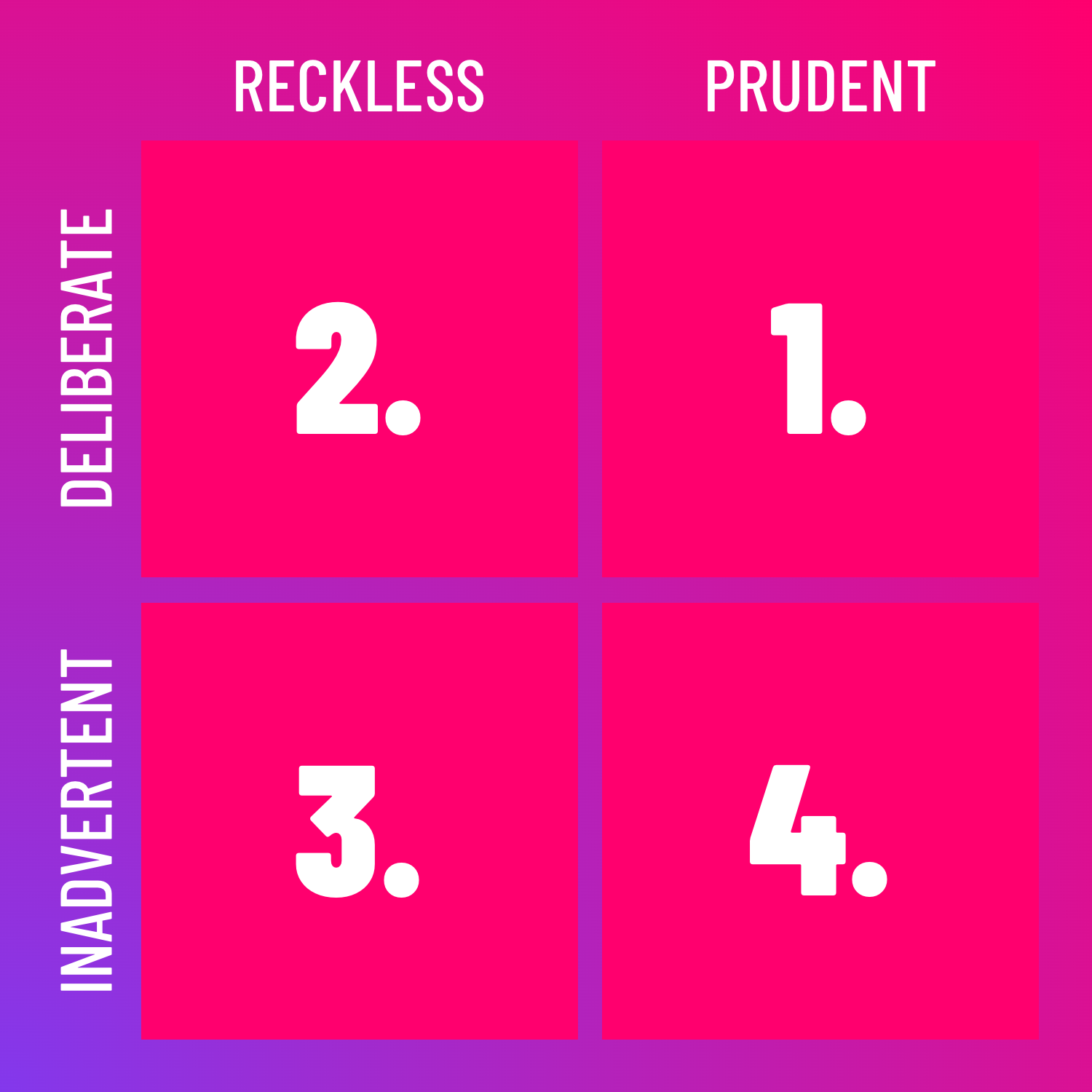
To manage tech debt, you need to know what kind of debt you have. Martin Fowler divides it into four quadrants.
Technical Debt Quadrant
Prudent & Deliberate: "We must release now and consciously accept the debt. We'll clean it up afterward." (The "good" loan).
Reckless & Deliberate: "We don't have time for design, just slap something together." (The dangerous loan).
Reckless & Inadvertent: "What's a design pattern anyway?" (The team doesn't know any better – only training helps here).
Prudent & Inadvertent: "Now that we're finished, we know how we should have built it." (Inevitable – you learn while coding).
"Let's go full throttle for the next three sprints, and after that, we'll do a refactoring sprint."
This is the biggest lie in software development. Refactoring sprints almost always fail for two reasons:
Prioritization: As soon as the refactoring sprint is due, a "Prio-1 customer request" comes in. Management will always be the first to cut a sprint that has no direct business value.
Isolation: Refactoring without context is hard to justify. Cleaning up code that won't be touched anyway is a waste.
Therefore: Refactoring must be a continuous process, not an event. If you try to pay down tech debt only in "bulk," it's usually already too late.
The Boy Scout Rule: Leave code cleaner than you found it
The only sustainable strategy against tech debt is the Boy Scout Rule.
"Always leave the code a little bit cleaner than you found it."
This means for your sprint:
When you work on a bug ticket, you clean up the ugly method right next to it. This "micro-refactoring" can also be part of your Definition of Done (DoD). You don't ask for permission for unit tests or clean variable naming – that is your professional standard. If you consider refactoring as an integral part of the story estimate, it becomes invisible (and thus untouchable) to management. It's simply the way you work.
Visualizing Tech Debt in the Backlog
Sometimes the debt is so large that the Boy Scout Rule is no longer enough. If you have to replace an entire architectural component, you need visibility.
The trick with "Red Tickets"
Put technical debt as real items into the Product Backlog. Mark them in color (e.g., Red). For the naming, here's a small trick: Don't call the task "Refactoring the Database Class" (the PO only hears: "Gold-Plating"). Instead, call it "Risk Mitigation: Reducing Latency and Fixing Errors in the Checkout Process." As soon as a technical debt has its own card in the backlog, the PO must actively decide: "Do I ignore this risk (and continue paying high interest) or do I invest in the future?"
Negotiation Strategies with the Product Owner
As developers, we tend to argue technically ("the coupling is too high"). Your PO, however, thinks in terms of opportunity costs. To get time for tech debt, you must speak their language. Here are several arguments you can put forward:
The Time Argument: "If we don't clean up this component now, all future features in this area will take twice as long. We'll lose our time-to-market."
The Risk Argument: "This code section is extremely unstable. If we don't stabilize it, we risk unpredictable system failures during peak season."
The Recruiting Argument: "Good developers don't want to work in a digital landfill. If we ignore quality, it will be harder to find new people or keep the current ones."
Tip: Use the Retrospective to make the pain caused by tech debt measurable. Point out how many story points you lost in the last sprint due to "interest payments" (unnecessary debugging).
🏗️ Negotiating Tech Debt: Your Economic Argumentation Guide
Stop talking about "beautiful code." Talk about money, time, and risk:
Management says...
Your response as a Pro Dev
"We don't have time for that; the business needs Feature X."
"Exactly because the business needs Feature X fast, we must clean up Module Y. If we don't pay down the interest on the technical debt there, Feature X will take twice as long as planned. Do we want to invest today or be slowed down tomorrow?"
"Can't we just do a quick fix?"
"A quick fix is a loan with extremely high interest. If we do that today, we must immediately schedule a ticket for repayment in the next sprint. Otherwise, we risk a system failure when the load increases next month."
"Why is refactoring so expensive?"
"Refactoring is not expensive; it's necessary maintenance. It's like an oil change for a car: You can ignore it to save $100 – until the engine failure costs you $5,000. We are currently protecting the value of our product."
Conclusion: Quality is an economic decision
Technical debt is inevitable, but it must not grow unchecked. An agile process is not a license for sloppiness. On the contrary: only those who keep their code clean stay agile in the long run. Learn to see tech debt not as a "developer problem," but as an economic risk for the product. Those who don't pay their interest will eventually be overtaken by the competition, which can deliver faster because their code doesn't hinder them.
What's Next? Technical debt is often just a symptom. The cause is usually a system that "starts" more work than it "finishes." Understand the physics behind your workflow.
Did this guide help you? Share it with your team or discuss it with me on Mastodon. Real feedback helps me make this content even better for devs!
]]>
Backlog Refinement Technique: Slicing Tickets Like a ProThomashttps://no-bullshit-agile.com/backlog-refinement-technique.html2025-12-23T20:57:39+01:00
This article is part of the Developer Survival Kit. Practical solutions to win back your focus time and deliver real results instead of just playing along in the "Agile Theater." Does this sound familiar? Sprint Planning starts, the Product Owner (PO) pulls the first ticket, and the next 60 minutes…
]]>
Practical solutions to win back your focus time and deliver real results instead of just playing along in the "Agile Theater."
Does this sound familiar? Sprint Planning starts, the Product Owner (PO) pulls the first ticket, and the next 60 minutes are spent discussing what "optimize user profile" actually means. In the end, you head into the sprint frustrated, without the slightest clue how to build the architecture for it.
This is the result of missing or poor Backlog Refinement.
Many teams view refinement as an optional "talk-fest." However, for the pragmatic developer, it is the most important event in the entire process. Why? Because this is where it's decided whether you can code in flow during the sprint or whether you have to close your IDE every two hours to clarify ambiguities.
Here is my guide on how to prepare your tickets so that planning becomes a mere formality.
Why Refinement is more important than Planning
In a perfectly running team, Sprint Planning is over in 30 minutes. Why? Because the hard work was already done during refinement. Planning is the moment we commit. Refinement is the process that makes us ready. If you only start understanding what needs to be built during planning, it's too late.
Refinement is less of a meeting and more of an activity. It's about preventing "Shit In, Shit Out." A ticket that isn't "Ready" must not enter the sprint. Period.
INVEST Criteria from a technical perspective
You’ve probably heard of INVEST. But let's forget the theory for a moment and look at what it means for your code:
Independent: Can you work on the ticket without waiting for another team? If no, slice it so you can work with mocks or interfaces.
Negotiable: A ticket is not a fixed specification. If the requirement is technically absurd, negotiate the solution. You are the expert for implementation; the PO is the expert for value.
Valuable: If you can't explain why a user needs this ticket, it might just be gold-plating or a technical end in itself.
Estimable: If you say "I can't estimate this," it usually means: "I haven't understood the problem yet." That's a sign for a Spike (see below).
Small: A ticket should be small enough to go through the pipeline in 2–3 days. Large tickets are hiding places for bugs and ambiguities.
Testable: If you don't know how to prove it works, the ticket isn't well-defined.
Vertical Slicing: The SPIDR Method
One of the biggest pain points for developers is "horizontal slicing." Teams often fall into creating one ticket for the DB, one for the API, and one for the UI. The result: at the end of the sprint, you have a lot of code but nothing that actually works.
We want vertical slicing. A thin cut through all layers. Mike Cohn developed the SPIDR framework for this, allowing you to break any user story into manageable pieces:
S – Spikes (Research)
If the story is too complex, pull out a Spike. Research the library or build a prototype. Only after that is the actual story estimated.
P – Paths
Slice by the "Happy Path" and the alternatives.
Story 1: User can log in with email (Happy Path).
Story 2: Forgot password function.
Story 3: OAuth integration.
I – Interfaces
Slice by devices or UI complexity.
Story 1: The API interface is ready (usable by other teams).
Story 2: The CLI tool works.
Story 3: The fancy web interface (comes later).
D – Data
Slice by data types or complexity of the data.
Story 1: We only support MP4 uploads (YouTube example).
Story 2: We add support for .mov and .webm.
R – Rules
Slice by business logic.
Story 1: User can post a comment.
Story 2: We add validation against SQL injection and profanity.
The advantage: you deliver something "alive" after every ticket, instead of standing in front of a pile of non-integrated layers at the end of the sprint.
Spikes: When we need to research before we estimate
I'm sure you hate having to guess. When the PO asks, "How long will the migration to the new GraphQL API take?", the most honest answer is often: "No idea, I've never done that before."
It may be that you (and your team members) are forced to give a Story Point number anyway. However, it's more successful for everyone to use a Spike.
A Spike is a time-boxed ticket (e.g., 4–8 hours) whose goal is not production code, but knowledge.
What have we learned?
What are the technical risks?
How can we reasonably slice the actual story now?
After the Spike, the uncertainty is gone, and planning becomes a breeze again.
Handling unclear requirements from the PO
Sometimes POs come with user stories that sound more like epic poems or (worse) a single cryptic sentence. Your job in refinement is to be the "gatekeeper" for your team.
Use a Definition of Ready (DoR). It is the counterpart to the Definition of Done. It's your quality standard for incoming work. A ticket is only "Ready" when:
The business context is clear.
The acceptance criteria are unambiguous.
Technical dependencies are clarified.
The ticket is small enough (slicing has occurred).
If a PO tries to push an unclear ticket into the sprint, your answer is:
"We’d love to help, but without clarity, we’re just producing waste. Let’s invest 10 minutes now to slice it according to SPIDR instead of running in the wrong direction for three days next week."
🎯 Force Clarity: Your Argumentation Guide
Don't let yourself be turned into a "ticket typist." Use these phrases to secure technical excellence even before the sprint starts:
If someone says...
Your response as a Pro Dev
"We don't have time for a spike, just start working on it."
"A spike isn't a waste of time; it's risk mitigation. If we start without a technical foundation, we risk the entire Sprint Goal blowing up on the second to last day. What's more important to you: a fast start or a reliable delivery?"
"The ticket is clear enough; you can clarify the details in the sprint."
"Unclear requirements are the biggest focus killer. If we have to close the IDE every two hours to ask questions, we lose our flow. Let’s invest 10 minutes now to slice the ticket cleanly using SPIDR."
"Why do we have to slice it so small? It’s just one feature."
"Small slices mean faster feedback and less risk during merges. We don’t want to grope in the dark for 10 days; we want to deliver real value (a vertical slice) every two days that you can show to the customer."
DoR Checklist
With the Definition of Ready, you have a checklist at hand to check whether a story is truly clarified enough for you to start.
Use this list as a guide in refinement. If a ticket gets a "No" or "Maybe" on more than two points, it’s not ready for the sprint. Send it back to the Product Owner's workshop.
1. Business Context ("The Why")
Value clear: We know who the target audience is and what real problem this ticket solves. (No "Because the boss wants it").
Success measurable: It’s clear how we will notice after the release that the feature works (e.g., tracking event, metric).
2. Functional Clarity ("The What")
Acceptance criteria present: There is a list of conditions that must be met for the PO to accept the ticket.
Edge cases considered: What happens in case of errors, empty states, or timeouts? (Rough clarification is enough).
UI/UX Ready: If the ticket affects the frontend: The designs/wireframes are final and accessible to the devs.
3. Technical Feasibility ("The How")
Dependencies clarified: We don't have to wait for Team X or API Y to start.
Architecture Fit: We roughly know which components the code will flow into. There are no "magical" unknowns.
Spike-Check: If we have no idea how to implement it, a research ticket (Spike) was completed first.
4. Logistics ("The Format")
Vertical Slicing: The ticket is sliced so that it goes through all layers (no pure "DB ticket").
Small enough: The team is confident that the ticket can pass through the pipeline within 2–3 days.
Estimation completed: The team has estimated the ticket together (or deliberately refrained because it is small enough).
Warning: No bureaucracy trap! The DoR is not a legal document to harass the PO. It is a communication tool. If a ticket is almost ready and you can clarify the remaining 5% during the sprint: Go for it. But if the ticket is a black hole of ambiguity: Hands off.
Conclusion: Refinement is Engineering
Stop seeing refinement as "meeting overhead." It is the moment you design the architecture of your sprint. Good slicing requires deep technical understanding – it is real engineering.
Those who masterfully slice their tickets reduce friction, eliminate overtime at the end of the sprint, and ensure that the team can concentrate on what it does best: building excellent software.
What's Next? Good refinement prevents surprises. But what about the code that already "stinks"? If legacy debt is slowing you down, you must learn to sell its removal economically.